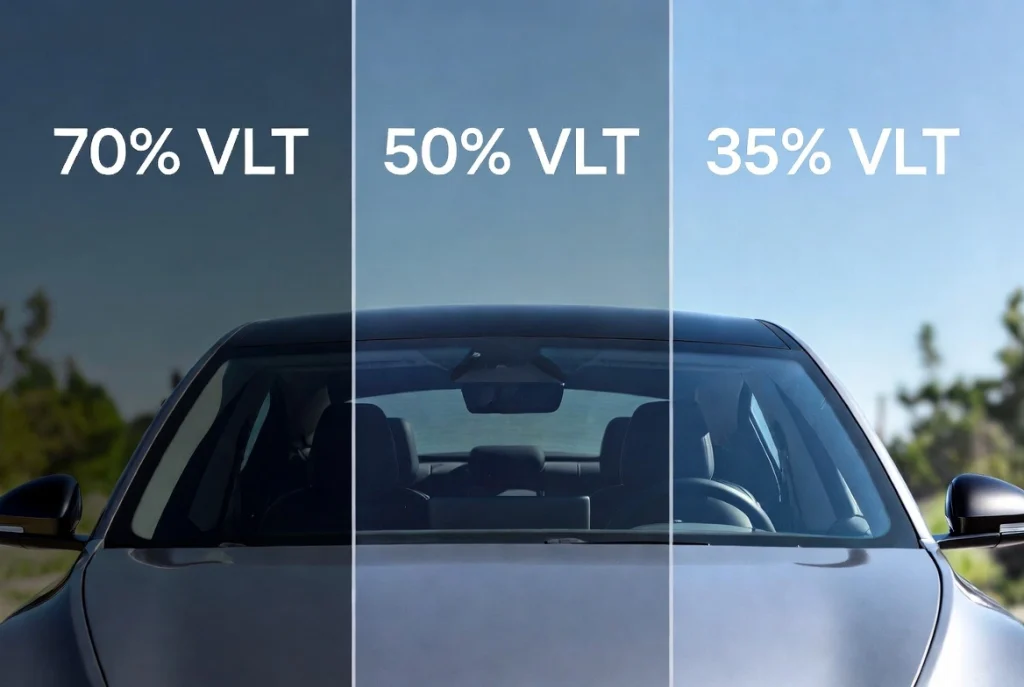

A 70–80%-class windshield film keeps the glass visually light. A 50% film produces more visible shading. A 35% film is dark for a full windshield. A 20% or 5% film removes too much visible light for our normal full-windshield recommendation.
Windshield tint performance depends on four separate attributes: visible-light transmission, total solar-energy rejection, ultraviolet rejection and film construction.

What is the best tint for a windshield?
The best windshield tint for most street-driven vehicles is a legal high-VLT ceramic or advanced optical film, usually in the 70–80%-class range, because it preserves forward visibility while providing heat and UV protection.
Windshield tint should preserve the windshield’s primary function: transmitting enough visible light for the driver to identify roads, vehicles, pedestrians, signs and hazards.
The windshield film should then add solar-energy rejection, UV rejection and glare control without requiring unnecessary darkness.
What does windshield tint percentage mean?
Windshield tint percentage measures visible-light transmission, or VLT, which is the percentage of visible light that passes through the tinted glazing.
A higher windshield-tint VLT produces lighter glass. A lower VLT produces darker glass.
Which windshield tint percentage is best for each goal?
The best windshield tint percentage changes with the driver’s priority: 70–80% favors visibility and solar performance, while lower VLT values increase visible shading and reduce transmitted visible light.
| Windshield goal | Starting VLT range | Primary attribute |
|---|---|---|
| Maximum forward visibility | 70–80%+ | High visible-light transmission |
| Heat rejection with a light appearance | 70–80% high-performance film | High TSER with high VLT |
| UV protection | High-VLT film with verified ~99% UV rejection | UV specification, not darkness |
| More daytime shading | Around 50%, where lawful and appropriate | Lower visible-light transmission |
| Maximum night visibility | Higher VLT | More visible light reaches the driver |
| Overhead solar glare | Legal upper windshield strip | Targets the upper viewing zone |
| Privacy | Use appropriate side/rear glass instead | The windshield is the primary forward viewing surface |
Is 80% tint good for a windshield?
An 80%-class windshield tint is a strong choice for drivers who want heat and UV performance with minimal visible darkening.
An 80%-class windshield film transmits most visible light and therefore preserves a near-clear appearance.
Premium ceramic and multilayer optical technologies allow high-VLT windshield tint to reject solar energy without depending on a dark shade.
For example, XPEL’s published XR Blue 80 data lists 78% VLT, 42% TSER and 99% UV rejection when tested on standardized 3 mm glass.
3M’s published Crystalline 80 data lists approximately 72% visible-light transmission, 48% TSER and 99% UV block under its stated laboratory conditions.
Is 70% tint good for a windshield?
A 70%-class windshield tint provides a strong balance of high visibility, subtle appearance and high-performance-film availability.
A 70%-class windshield film remains visually light, but the exact product can measure above or below its nominal shade name.
XPEL lists XR PLUS 70 at 67% VLT under its standardized test conditions.
XPEL lists the same XR PLUS 70 at 52% TSER, 99% UV rejection and 92% infrared rejection across 780–1700 nm.
XPEL CS Black 70 provides a useful material comparison because it measures 70% VLT and 99% UV rejection but only 24% TSER and 27% infrared rejection across 780–1700 nm.
Is 50% tint good for a windshield?
A 50%-class windshield tint provides more visible shading and glare reduction than 70–80% film, but it also reduces forward light and faces more legal restrictions.
A 50% windshield film transmits roughly half of the visible light under the stated measurement condition.
The reduced transmission becomes more noticeable on dark roads, during rain and in poorly illuminated environments.
A 50%-class windshield tint therefore suits a narrower set of legal jurisdictions and driver preferences than high-VLT windshield film.
Is 35% tint good for a full windshield?
A 35%-class windshield tint is too dark for our normal full-windshield recommendation because it removes substantially more visible light from the driver’s primary viewing surface.
A 35% windshield film transmits roughly one-third of visible light under its stated test condition.
The darker windshield increases the difference between daylight performance and night, rain or low-light performance.
A 35%-class film fits upper windshield shade-band applications more naturally where the law permits that configuration.
Should 20% or 5% tint cover a full windshield?
Twenty-percent and 5% windshield tint should not cover the full primary viewing area of a normal street-driven vehicle because both shades severely reduce visible-light transmission.
| Windshield shade | Approximate visible-light relationship | Better application |
|---|---|---|
| 20% | Transmits about one-fifth of visible light | Privacy-oriented side/rear glass where legal |
| 5% | Transmits about one-twentieth of visible light | Very-dark rear/privacy glass where legal |
Dark windshield tint solves a privacy problem by removing visible light, while full-windshield tint must preserve forward visibility.
What is the best windshield tint material?
Nano-ceramic windshield tint is the strongest overall material choice when the driver wants high heat rejection, high UV rejection, optical clarity and non-metal construction.
Ceramic windshield film uses microscopic ceramic materials rather than metallic layers to manage solar energy.
Premium ceramic construction allows strong heat performance at high VLT, which matches the windshield’s need for both solar rejection and visibility.
| Windshield film material | Main construction | Main advantage | Main limitation |
|---|---|---|---|
| Nano-ceramic | Non-metal ceramic particles/layers | High heat performance at high VLT | Higher cost |
| Multilayer optical | Many specialized optical layers | Strong solar performance with light appearance | Premium pricing and product-specific availability |
| Carbon | Carbon-based film construction | Non-metal, product-dependent heat performance | Performance varies widely by manufacturer |
| Color-stable dyed | Color-stable dye technology | Lower cost and stable appearance | Lower solar performance than premium ceramic products at similar VLT |
| Metalized | Metal-containing layers | Can reject solar energy effectively | Reflectivity and electronics compatibility require product-specific evaluation |
Our window tint material guide compares ceramic, dyed, carbon, metallic and related film technologies in more detail.
Why is ceramic windshield tint better for high-VLT applications?
Ceramic windshield tint performs well at high VLT because its solar-control technology does not rely on making the glass extremely dark.
Windshield tint needs high visible-light transmission because the driver continuously looks through the glass.
Ceramic film adds infrared and solar-energy rejection through its material construction while retaining relatively high VLT.
Does darker windshield tint reject more heat?
No. Darker windshield tint does not automatically reject more heat because VLT measures visible light while TSER measures total solar-energy rejection.
Windshield tint heat performance depends on film construction, solar transmittance, solar reflectance and absorbed solar energy.
The International Window Film Association defines Total Solar Energy Rejection as the inverse of Solar Heat Gain Coefficient.
A higher TSER therefore indicates that the film/glass system rejects a greater fraction of total incident solar energy.
| Official XPEL film | VLT | TSER | UV rejection | IR rejection 780–1700 nm |
|---|---|---|---|---|
| XR PLUS 70 | 67% | 52% | 99% | 92% |
| CS Black 70 | 70% | 24% | 99% | 27% |
These two films have similar visible-light transmission and identical published UV rejection, but XR PLUS 70 provides more than twice the published TSER of CS Black 70.
What is the best windshield tint for heat rejection?
The best windshield tint for heat rejection is a legal high-VLT ceramic or advanced optical film with high verified TSER and strong infrared-energy rejection.
Windshield tint heat rejection should be evaluated with total solar-energy data rather than a darkness percentage alone.
XPEL XR PLUS 70 publishes 52% TSER at 67% VLT.
3M Crystalline 70 publishes approximately 54% TSER at 64% visible-light transmission under 3M’s stated test conditions.
3M Crystalline 80 publishes approximately 48% TSER while maintaining approximately 72% visible-light transmission.
What is the best windshield tint for UV protection?
The best windshield tint for UV protection is a quality film with about 99% verified UV rejection; high-VLT ceramic or multilayer optical film adds that UV protection without requiring a dark windshield.
Windshield tint UV rejection measures ultraviolet radiation blocked by the film, while VLT measures visible light transmitted through the film.
The two attributes operate independently.
| Windshield tint attribute | Meaning | UV-focused target |
|---|---|---|
| UV rejection | Percentage of ultraviolet radiation rejected | Approximately 99% from a verified specification |
| VLT | Percentage of visible light transmitted | High enough for visibility and applicable law |
| Material | Film construction that controls broader performance | Ceramic or advanced optical when heat performance also matters |
| Shade | Visible darkness | Does not determine UV rejection by itself |
XPEL publishes 99% UV rejection for both XR PLUS 70 and CS Black 70 despite their large difference in TSER and infrared performance.
LLumar also states that its ceramic automotive films block up to 99% of damaging UV radiation.
Our car-window UV protection guide explains UV transmission, glazing and film protection in more detail.
What is the best windshield tint for glare reduction?
The best windshield tint for general glare control is a high-VLT film that reduces visible brightness without unnecessarily reducing forward visibility.
Windshield tint reduces glare by reducing visible-light transmission.
The International Window Film Association defines glare as reduced visual performance when light intensity exceeds the eye’s ability to adapt.
Lower-VLT windshield film generally reduces more visible glare, but it also removes more useful visible light.
| Glare source | Windshield tint response |
|---|---|
| Bright daytime sky | High-VLT full-windshield film provides modest broad glare control. |
| Overhead sun | A lawful upper shade band targets the highest windshield area more directly. |
| Low-angle sunrise/sunset | Windshield film can reduce brightness, but visor position and sunglasses remain important. |
| Night headlights | Darker windshield tint reduces all visible light and therefore is not a targeted headlight-glare solution. |
What windshield tint is best for night driving?
A high-VLT windshield tint is best for night driving because it preserves more visible light than 50%, 35%, 20% or 5% film.
Windshield tint reduces incoming visible light in proportion to its transmission characteristics.
Night driving already provides less ambient light, so additional windshield darkening has a greater practical effect in low illumination.
| VLT class | Night-driving relationship |
|---|---|
| 80%+ | Retains the greatest amount of visible light among these examples. |
| 70% | Retains high visible-light transmission with subtle shading. |
| 50% | Removes substantially more visible light. |
| 35% | Produces a strong reduction in forward visible-light transmission. |
| 20% / 5% | Produces extreme darkness for a primary forward viewing surface. |
Windshield tint visibility matters most on unlit roads, during rain, in fog and around low-contrast pedestrians or objects.
Does factory windshield glass change the final tint percentage?
Yes. Factory windshield glass changes the final VLT because aftermarket film is added to glazing that already has its own visible-light transmission.
Windshield glazing can include laminated safety glass, acoustic interlayers, solar-control layers, UV absorbers, infrared coatings and manufacturer-specific construction.
A film labeled 70% therefore does not guarantee that the completed windshield will measure 70%.
This relationship matters most when the legal minimum sits close to the measured result.
Is full-windshield tint better than a windshield sun strip?
Full-windshield tint is better for broad heat and UV protection, while an upper windshield strip is better for concentrated overhead glare.
| Windshield tint format | Main function | Typical material strategy |
|---|---|---|
| Full windshield | Solar heat, UV exposure and broad glare reduction | High-VLT high-performance film |
| Upper shade band | Blocks direct solar brightness near the windshield top | Darker film can be used where local law allows |
Windshield tint legality for both configurations depends on the jurisdiction where the vehicle is operated.
Does ceramic windshield tint interfere with vehicle electronics?
Non-metal ceramic windshield tint does not use metallic layers, so it avoids the metal-related signal-interference concern associated with some metalized films.
Ceramic windshield tint therefore fits vehicles that depend on GPS, cellular connectivity, Bluetooth, satellite radio and connected-car systems.
Our XPEL PRIME XR Plus film uses nano-ceramic technology and contains no metallic layer used for solar rejection.
Our XPEL window tint guide explains how our XPEL film families differ.
Which windshield systems should be checked before tint installation?
Windshield tint installation should account for cameras, sensors, head-up displays, antennas, heated elements and factory solar coatings before film is applied.
Modern windshield systems can include:
- Forward cameras support lane and collision systems.
- Rain sensors detect moisture near the mirror housing.
- Light sensors control lighting and display behavior.
- HUD zones project information through specialized glass.
- Antennas can occupy glazing or surrounding structures.
- Heated areas use conductive elements for deicing.
- Solar coatings already alter the windshield’s energy transmission.
Windshield tint product selection should remain compatible with the specific glazing and electronics package.
How does windshield tint compare with factory privacy glass?
Windshield tint is an applied performance film, while factory privacy glass is colored glazing primarily used on rear vehicle glass to reduce visible-light transmission.
Factory privacy glass can appear dark without providing the same solar-performance values as a premium aftermarket ceramic film.
Aftermarket windshield film can add verified heat and UV performance at a much lighter appearance.


What windshield tint material provides the best value?
Color-stable dyed windshield film provides lower-cost UV protection, while ceramic windshield film provides greater solar-performance value when heat rejection is a priority.
The correct value comparison depends on the attribute being purchased.
| Priority | Better material direction | Reason |
|---|---|---|
| Lowest initial cost | Color-stable dyed | Lower material cost |
| UV protection | Any quality film with verified ~99% UV rejection | UV specification matters more than material label alone |
| Maximum heat performance | Ceramic / advanced optical | Higher TSER can be achieved at high VLT |
| Signal compatibility | Non-metal ceramic / non-metal film | No metallic solar-control layer |
| High-VLT windshield use | Ceramic / advanced optical | Strong performance without heavy visible darkening |
What windshield tint do we install?
We currently install XPEL PRIME CS Black and XPEL PRIME XR Plus, with XR Plus serving as our premium ceramic-performance option.
XPEL PRIME CS Black
We use PRIME CS Black as our value-oriented color-stable film. XPEL publishes 99% UV rejection for CS Black 70 and 24% TSER under its standardized test conditions.
XPEL PRIME XR Plus
We use PRIME XR Plus when heat rejection and premium ceramic performance are the priority. XR PLUS 70 publishes 52% TSER, 99% UV rejection and 92% IR rejection across 780–1700 nm.
We select film by the vehicle
We evaluate the glass, desired VLT, heat goal, UV goal, legal limits and existing glazing before recommending the film configuration.
Our window tint service page contains our current film options, installation process and commercial pricing.
Is windshield tint legal everywhere?
No. Windshield tint legality varies by country, state and province, so no aftermarket windshield percentage is universally legal.
Windshield tint laws commonly regulate:
- VLT limits control minimum visible-light transmission.
- Shade-band limits control how far upper tint may extend.
- Reflectivity rules control mirror-like films.
- Color rules restrict specific tint colors.
- Medical exemptions allow defined exceptions in some jurisdictions.
- Certification rules require markings or documents in some areas.
In the United States, FMVSS No. 205 requires at least 70% light transmission in glazing areas required for driving visibility on new vehicles and replacement glazing; aftermarket operation also depends on state law.
What windshield tint is legal in Ohio?
Ohio permits aftermarket windshield material when the film and safety glazing together transmit at least 70% light, subject to the rule’s ±3% tolerance.
Ohio windshield tint law also permits an upper shade band that does not extend below the AS-1 line or five inches from the windshield top, whichever is closer to the top.
Ohio prohibits reflectorized material on the windshield.
Ohio also requires identification labels for sunscreening material on covered model-year vehicles.
Our Ohio window tint law guide covers the windshield, front side windows, rear glass and local compliance in more detail.
Why does professional windshield tint installation matter?
Professional windshield tint installation improves optical clarity, edge quality, contamination control and film conformity across the windshield’s large curved surface.
Windshield tint defects remain directly inside the driver’s view, which makes installation quality more important than on many rear-glass positions.
We install window tint in our controlled studio rather than as a driveway service.
Our windshield and window-tint workflow follows five connected stages:
Our vehicle protection services separate studio-installed tint, ceramic coating and paint protection film from our mobile detailing operation.
How should you choose windshield tint?
Choose windshield tint by matching legal VLT, visibility, solar performance, UV rejection and film material to the vehicle and driver’s use.
| Driver priority | Windshield tint direction |
|---|---|
| Maximum clarity | Highest practical high-performance VLT |
| Heat rejection | High-VLT ceramic or advanced optical film with high TSER |
| UV protection | Film with approximately 99% verified UV rejection |
| Night driving | Higher VLT |
| Daytime glare | High-VLT full film or lawful upper shade band depending on glare location |
| Electronic compatibility | Non-metal ceramic or equivalent non-metal technology |
| Lower cost | Quality color-stable film with verified specifications |
| Premium overall performance | High-VLT ceramic film |
What is the best windshield tint overall?
The best windshield tint overall is a legal high-VLT ceramic or advanced optical film that preserves forward visibility while providing high TSER, about 99% verified UV rejection and strong optical clarity.
Windshield tint percentage determines visible-light transmission.
Windshield tint material determines much of the film’s heat-performance potential.
Windshield tint UV protection depends on its verified UV-rejection specification.
Windshield tint legality depends on the finished glazing and the jurisdiction.
| Windshield tint option | Best use |
|---|---|
| 80%-class ceramic / optical | Near-clear appearance with solar and UV performance |
| 70%-class ceramic | Strong general balance of visibility and performance |
| 50% | More visible shading where law and driving conditions support it |
| 35% | Dark windshield use; better suited to lawful shade-band applications than normal full-windshield coverage |
| 20% / 5% | Privacy-oriented side/rear applications rather than a normal full windshield |
| Ceramic | Best overall material direction for high-VLT heat performance |
Want us to match the windshield film to your vehicle?
We inspect the existing glass, define your visibility, heat, UV and appearance goals, verify the applicable tint limits and recommend the XPEL film that matches the windshield and the rest of the vehicle.
View Our Window Tint OptionsTechnical sources
XPEL PRIME USA Specification Sheet. Used for measured VLT, TSER, UV rejection, glare reduction and wavelength-defined infrared-rejection values for XR PLUS, XR, HP and CS films.
International Window Film Association Automotive Education Guide. Used for VLT, Solar Heat Gain Coefficient, Total Solar Energy Rejection, glare and infrared-measurement definitions.
3M Crystalline Automotive Window Film Technical Data. Used as an independent multilayer-optical example showing that high-VLT films can provide substantial TSER and UV rejection.
LLumar Ceramic Automotive Window Film. Used as an independent ceramic-film source confirming nano-ceramic heat rejection and up to 99% UV blocking.
NHTSA / FMVSS No. 205 interpretations. Used for federal glazing-transmission context and the 70% requirement for glazing areas required for driving visibility on new and replacement glazing.
Ohio Administrative Code Rule 4501-41-03. Used only for the Ohio-specific section covering combined windshield transmission, upper shade-band placement, reflectivity and labeling requirements.
Our Window Tint service page. Used for our current XPEL PRIME CS Black and PRIME XR Plus services, controlled-studio installation and lifetime-warranty information.
Film specifications differ by product, test method, substrate and market. Compare manufacturer values measured under stated conditions rather than assuming a material category or tint percentage guarantees a specific result.