
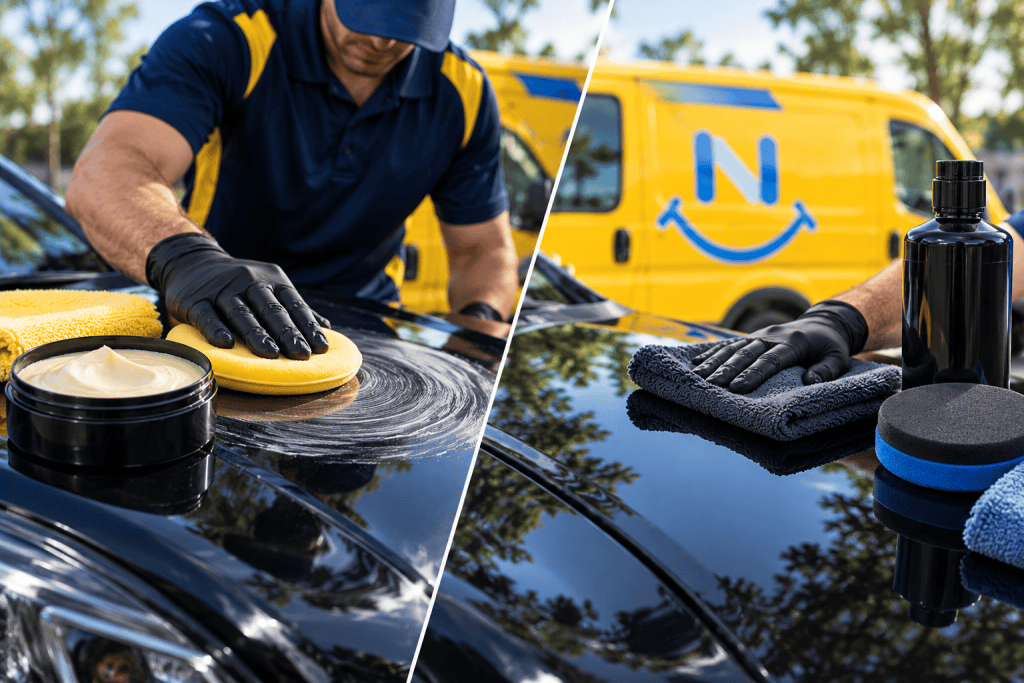

Car wax and paint sealant are both temporary protective layers applied over prepared automotive paint, but the useful difference is formulation, service interval and maintenance—not simply “natural versus synthetic.” Traditional waxes may use carnauba or other waxes, while modern wax products can also contain synthetic polymers or ceramic additives. Paint sealants are generally synthetic polymer, silicone or resin-based systems. Both can increase gloss, water repellency and ease of maintenance. In our current Premium Complete mobile detail, we use Premium wax advertised for up to 3 months. We do not currently list a standalone paint-sealant application as a mobile-package inclusion.
What is the real difference between car wax and paint sealant?
The strongest semantic distinction is paint surface → preparation → protective film → exposure → maintenance → renewal.
Wax and sealant both sit above the vehicle’s paint system as sacrificial protection. Neither repairs clear-coat failure, removes scratches or stops stone impacts. Their job is to change the behavior of the exposed surface—typically gloss, slickness, water behavior, soil release and short-term chemical exposure—until the protection degrades or is removed.
The category names describe different formulation traditions. Traditional waxes may use natural waxes such as carnauba, but modern products sold as “wax” can contain synthetic polymers, silicones or SiO₂-derived ingredients. Paint sealants are generally marketed as synthetic protection systems built around polymers, silicones or resins.
For the broader protection hierarchy, our guide to protection products used after mobile car detailing separates temporary paint protection from surface-specific glass, wheel, fabric and leather protection and from our separate professional coating services.
Wax
Temporary paint protection that may be traditional, synthetic or hybrid depending on the identified product.
Sealant
Usually synthetic polymer, silicone or resin-based protection designed for persistent water repellency and easier maintenance.
Coating
A separate protection category with product-specific preparation, installation, cure and maintenance requirements.
Wax vs paint sealant comparison matrix
| Comparison | Car wax | Synthetic paint sealant | Why it matters |
|---|---|---|---|
| Typical formulation | May contain natural waxes, synthetic polymers, silicones or hybrid/ceramic ingredients. | Generally synthetic polymers, silicones, resins or related protection chemistry. | The marketing name does not reveal the complete formula. |
| Primary function | Temporary gloss, slickness, water behavior and sacrificial protection. | Temporary synthetic protection with emphasis on persistent water repellency and maintenance. | Both are surface protection, not body repair. |
| Appearance | Product-specific; traditional wax is often marketed for warmth or depth. | Product-specific; sealants are often marketed for reflectivity and slickness. | Appearance is not a universal category score. |
| Durability | Varies widely. Our current Premium wax is advertised for up to 3 months. | Often positioned for a longer temporary interval. SONAX Polymer Net Shield is advertised for up to 6 months. | Use named-product claims rather than folklore. |
| Application | Paste, liquid, spray or hybrid; hand/machine use depends on product. | Liquid, spray or aerosol; wipe/cure behavior depends on product. | Application instructions are formulation-specific. |
| Maintenance | Compatible washing and reapplication as performance declines. | Compatible washing and renewal/topper only where product system allows. | Maintenance can shorten or preserve either product’s observable life. |
| Impact protection | No. | No. | Paint protection film is the physical-film category for rock-chip exposure. |
Why “wax is natural and sealant is synthetic” is too simplistic
Carnauba is a real wax ingredient, but finished automotive wax is a formulated product—not a block of pure plant wax applied directly to paint. Current waxes may combine traditional waxes with synthetic polymers, silicone chemistry or ceramic-related additives.
Sealants are more consistently synthetic by category. Meguiar’s identifies M21 Synthetic Sealant 2.0 as a synthetic polymer formulation. Its current ingredient disclosure includes dimethicone, organo-modified silicone, oxidized polyalkylene and a silicone polymer among other ingredients. SONAX describes Polymer Net Shield as a wax-free paintwork sealant with polymer protection.
Does wax always create a warmer or deeper gloss?
No. Traditional carnauba-style waxes are often marketed for warmth, richness or depth, especially on dark paint, but appearance is subjective and formulation-specific.
Paint condition matters more than many customers expect. Swirls, oxidation, haze and bonded contamination remain below the protection layer. Wax can change gloss and slickness, but it does not perform the clear-coat leveling done during machine polishing.
That is why our mobile-detailing package guide separates cleaning, decontamination, polishing and protection as different operations.
Does sealant always look sharper or more reflective?
No. Meguiar’s describes M21 as creating a deeper, darker and more reflective finish, but that is a claim for one identified sealant—not a rule for every sealant relative to every wax.
The defensible comparison is: finish character is product-specific; protection strategy is category-dependent.
How much longer can a paint sealant last than wax?
The correct comparison uses identified products or service claims. Category-wide durability numbers are too broad because traditional waxes, hybrid waxes and sealants now overlap.
| Named example | Category | Published durability | What it proves |
|---|---|---|---|
| Our Premium Complete protection | Premium wax | Up to 3 months | Our current mobile wax service claim—not a lifespan for all wax. |
| SONAX Polymer Net Shield | Wax-free polymer sealant | Up to 6 months | A manufacturer example of longer temporary synthetic protection. |
| Our Platinum Complete protection | Ceramic wax | Up to 9 months | Shows why the word “wax” no longer guarantees a traditional short interval. |
| Our studio XPEL systems | Professional ceramic coating | 2-, 5- or 8-year packages | A separate protection/service class with different preparation and maintenance. |
What changes during application?
Both categories require clean paint, but the exact application behavior can be very different. SONAX Polymer Net Shield, for example, instructs users to work on clean, dry paint, spread product evenly over partial areas, wipe to a streak-free finish, avoid hot surfaces and not allow the product to dry. Meguiar’s M21 is formulated for hand, dual-action or rotary application.
| Application variable | Wax | Sealant | Actionable check |
|---|---|---|---|
| Paint cleanliness | Required | Required | If bonded contamination remains, protection can preserve the roughness rather than fix it. |
| Surface temperature | Product-specific | Product-specific; some explicitly prohibit hot surfaces | Check panel temperature and label instructions. |
| Amount | Usually thin/even; product-specific | Usually thin/even; product-specific | More product does not automatically create more durability. |
| Dwell / haze / flash | Varies | Varies | Do not reuse timing from another product. |
| Removal | Clean microfiber / method per label | Clean microfiber / method per label | Streaking can signal excess product, wrong timing or loaded towel. |
| Cure / wet exposure | Varies widely | Varies widely | Only claim cure time when the exact product publishes one. |
How much preparation is needed before wax or sealant?
Preparation should match the paint condition and service objective. At minimum, removable wash contamination needs to be gone. If the paint is rough after washing, bonded contamination may need a separate decontamination step. If the paint looks swirled or hazy, polishing is a correction decision—not a protection decision.
Our Premium Complete mobile detail currently includes exterior washing followed by Premium wax advertised for up to three months. Our Platinum Complete adds clay decontamination and high-gloss machine polishing before ceramic wax advertised for up to nine months. That package structure illustrates a key concept: preparation depth and protection category are separate variables.
Paint feels smooth
Routine cleaning may be enough before a compatible temporary protectant.
Paint feels rough
Evaluate bonded contamination before sealing it under a fresh protection layer.
Paint looks swirled
Protection will not mechanically remove the defect; polishing may be a separate step.
What shortens wax or sealant durability?
Durability is a system outcome, not only a product property. The same bottle can perform differently on two vehicles because the vehicles experience different washing, weather and contamination.
| Durability factor | What it changes | Actionable response |
|---|---|---|
| Harsh wash chemistry | Can strip or weaken temporary protection faster. | Use compatible wash chemistry and avoid unnecessary high-strength degreasers on protected paint. |
| Abrasive washing | Adds micro-marring and physically stresses the film. | Use clean wash media and low-friction drying. |
| Outdoor UV / weather exposure | Increases environmental stress. | Expect shorter intervals on vehicles stored outside full-time. |
| Road salt / winter contamination | Raises chemical and cleaning load. | Rinse and wash more consistently during Northeast Ohio winter use. |
| Long contamination dwell | Bug residue, bird droppings and sap remain on the protection longer. | Remove aggressive contamination promptly with compatible methods. |
| Poor initial preparation | Can reduce uniformity and make the protected surface feel or look worse. | Clean/decontaminate/polish to the required level before application. |
Can wax be applied over paint sealant?
Sometimes—if the exact products are compatible. The traditional sequence is sealant for persistence, then wax as a cosmetic topper. That approach can work, but modern hybrid formulas make it less universal.
Some sealants already deliver gloss, slickness and water behavior. Some waxes already contain synthetic polymers or ceramic ingredients. Layering can also make diagnosis harder because the surface behavior no longer tells you which product is still active.
Can sealant be applied over old wax?
It depends on the product, but a sealant generally performs most predictably when applied to a surface prepared according to its instructions.
3M’s paint-protection-film preparation guidance gives a useful external example: it instructs installers to remove surface residue such as wax and paint sealant before film installation. That does not mean every sealant requires total wax stripping—but it proves existing protection can affect adhesion and the next protection system.
How are wax and sealant different from ceramic coating?
Wax, sealant and ceramic coating all belong to paint protection, but they are not interchangeable service terms. Our ceramic coating service uses identified XPEL systems with 2-, 5- and 8-year package/warranty terms and a separate preparation/install process.
Our current coating guidance also recommends decontamination and paint enhancement before coating because coating over defects can preserve their visibility for the life of the coating. That is a different service architecture from renewing a temporary wax or sealant.
| Protection category | Service role | Typical renewal model | What it does not replace |
|---|---|---|---|
| Wax | Temporary sacrificial protection / finish enhancement | Periodic reapplication | Paint correction or rock-chip protection |
| Paint sealant | Temporary synthetic protection | Product-specific periodic renewal | Paint correction or rock-chip protection |
| Ceramic wax / spray protection | Hybrid temporary protection | Product-specific renewal | Professional coating installation |
| Professional ceramic coating | Dedicated cured coating system | Multi-year package plus maintenance | Physical impact protection |
| Paint protection film | Physical film for high-impact paint zones | Film-specific care/replacement | Routine washing or chemical protection |
For the complete physical-vs-chemical protection hierarchy, our vehicle protection services and paint protection film pages separate gloss/hydrophobic protection from stone-impact protection.
Which one should a driver choose?
The useful decision is not “which category wins?” It is “which verified product and service interval fit the vehicle’s use?”
| Priority | Wax can fit when… | Sealant can fit when… | Next question |
|---|---|---|---|
| Shorter maintenance cycle | A known wax has the desired finish and interval. | Longer persistence is unnecessary. | How often will the vehicle be detailed? |
| Longer temporary protection | A hybrid wax has a verified longer claim. | A named sealant has a documented interval that matches the goal. | What exact product is being installed? |
| Appearance priority | The identified wax produces the desired finish on that paint. | The identified sealant produces the desired finish on that paint. | Is the paint already defect-free enough to showcase the finish? |
| Outdoor daily driver | Wax can still fit if frequent renewal is acceptable. | Longer temporary persistence may reduce renewal frequency. | How is the car washed and stored? |
| Multi-year protection | Move to a coating comparison. | Move to a coating comparison. | Is a professional ceramic coating the actual goal? |
| Rock-chip exposure | Not the right protection mechanism. | Not the right protection mechanism. | Compare PPF. |
Action checklist before applying wax or sealant
- Confirm the vehicle is clean and the panel is suitable for product application.
- Run a clean hand or inspection method over the paint: if it feels rough, evaluate bonded contamination before protection.
- Inspect under directional light for swirls, oxidation, haze and deeper scratches.
- Decide whether correction is actually part of the service; do not call wax or sealant “paint correction.”
- Identify existing wax, sealant, coating or PPF before adding another protection product.
- Check the exact product’s temperature, dwell, wipe-off and cure instructions.
- Apply the minimum even amount required; excessive product usually creates removal problems, not extra protection.
- Use clean application and removal towels so trapped contamination is not dragged across the paint.
- Give aftercare instructions that match the product actually installed.
- Record the protection category and service date so future maintenance is not based on guessing.
How do we explain wax and paint sealant to customers?
We separate the category from the claim. “Wax” does not automatically mean pure carnauba or one fixed lifespan. “Paint sealant” does not automatically mean six months. We identify the actual service, preparation and published duration instead.
For our current mobile services, the claim is specific: our Premium Complete package includes Premium wax advertised for up to three months. Our Platinum Complete package includes clay decontamination, high-gloss machine polishing and ceramic wax advertised for up to nine months. Our multi-year XPEL ceramic coatings are separate studio services.
This same hierarchy is explained in our protection-products guide and in what our mobile detailing packages include, so customers can follow the entity chain from cleaning → preparation → protection → maintenance without mixing the services together.
Need paint protection after detailing in Northeast Ohio?
We can match the protection step to the vehicle, paint condition and service depth—from the Premium wax included in our mobile detailing package to enhanced ceramic protection and separate multi-year studio ceramic coatings.
Explore Mobile Car DetailingEvidence and technical references
[1] Nathan’s Detailing — Mobile Car Detailing. Our current Premium Complete package lists Premium wax protection up to three months. Platinum Complete lists clay decontamination, high-gloss machine polishing and ceramic wax protection up to nine months.
[2] Nathan’s Detailing — Ceramic Coating. Our current coating service separates professional XPEL coating systems from temporary mobile protection and identifies coating-specific preparation and maintenance.
[3] Meguiar’s — Professional M21 Synthetic Sealant 2.0. Meguiar’s identifies M21 as a synthetic polymer formulation providing hydrophobic behavior, gloss and water beading; its current ingredient disclosure includes multiple silicone/polymer functional ingredients.
[4] SONAX — PROFILINE Polymer Net Shield. SONAX identifies the product as a wax-free paintwork sealant with polymer protection up to six months and specifies clean, dry paint, partial-area application and streak-free removal.
[5] 3M — Paint Protection Film Installation Guideline / Protection Wrap Film Installation Guide. 3M instructs installers to remove wax and paint-sealant residues during film preparation, demonstrating that these surface products can materially affect a subsequent protection system.
[6] Nathan’s Detailing — Paint Protection Film. PPF is a separate physical-film protection service for impact-prone paint areas and should not be conflated with wax or paint sealant.
Exact formulation, compatibility and durability vary by product. The product label, technical data and our current service description control if they differ from generic category descriptions.