
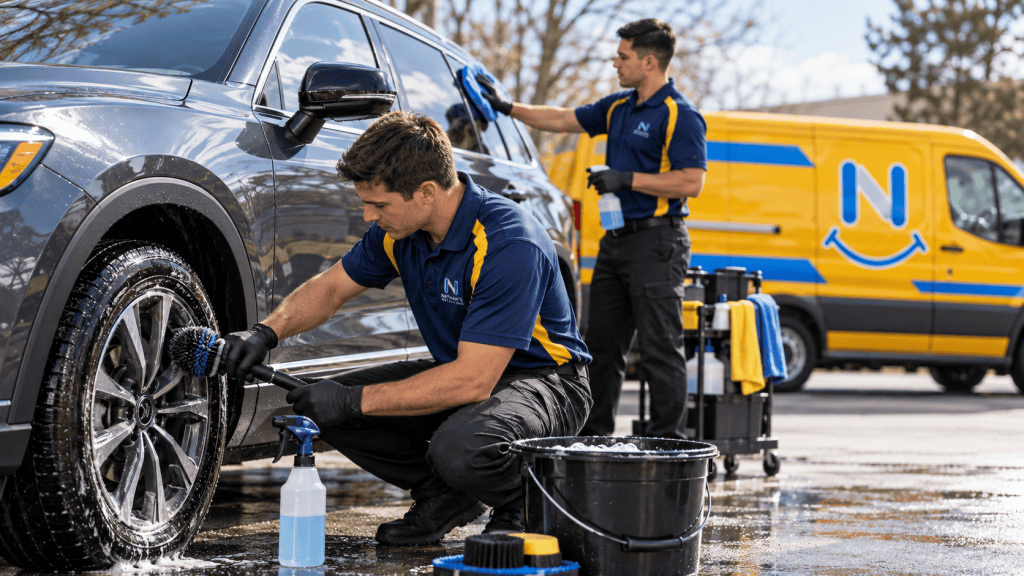

During mobile car detailing, wheels, tires and exterior glass are cleaned as separate surface systems. Wheel faces and barrels are rinsed, treated with a finish-compatible wheel cleaner, agitated with dedicated brushes and rinsed thoroughly; tire sidewalls are cleaned with rubber-compatible chemistry and a separate tire brush; exterior glass is washed and then refined with a non-abrasive automotive glass cleaner and clean glass towels. The chemicals, agitation tools and finishing products differ because painted or coated wheels, tire rubber and transparent glass do not respond to contamination in the same way.
Why should wheels, tires and glass not be cleaned as one exterior surface?
All three areas live outside the vehicle, but they operate under different physical and chemical conditions.
Wheels sit next to the braking system and collect road film, brake dust and grime on visible faces, spokes, lug areas and inner barrels. Tires are flexible rubber structures whose sidewalls can hold road soil, old dressing and normal rubber-bloom discoloration. Exterior glass needs optical clarity and low residue because streaks, haze and contamination can interfere with visibility.
The detailing process therefore separates surface → contamination → chemistry → tool → recovery → finish. That same material-first logic is used throughout mobile detailing cleaning methods.
Wheels
Finish-sensitive hard surfaces exposed to brake dust, road film and heat from nearby braking components.
Tire sidewalls
Flexible rubber that needs soil removal without treating the tread like a cosmetic surface.
Exterior glass
Transparent surfaces where cleaner residue, towel lint and abrasion become visibility problems rather than only appearance problems.
Surface-to-method comparison: what changes between wheels, tires and glass?
| Surface zone | Typical removable contamination | Primary chemistry | Primary tool | Finish step | Main risk to manage |
|---|---|---|---|---|---|
| Wheel face | Loose road dirt, brake dust, ordinary traffic film | Wheel-finish-compatible cleaner or shampoo | Soft wheel brush, sponge or mitt dedicated to wheels | Rinse and dry; compatible wheel protection if included | Staining, clear-coat damage, scratching, cleaner drying on a hot surface |
| Wheel barrel | Heavier brake dust and road film | Same compatible wheel chemistry, selected for the finish | Long-reach barrel brush | Thorough rinse and drainage | Incomplete rinsing, contact with brake components, aggressive brush impact |
| Tire sidewall | Road soil, old dressing, normal surface browning, dust | Rubber-compatible, non-petroleum cleaner or mild soap/water where appropriate | Dedicated stiff-but-safe tire brush | Dry; optional compatible sidewall dressing | Chemical incompatibility, dressing transfer, contamination of tread or brakes |
| Exterior glass | Loose dirt, wash film, fingerprints, ordinary traffic film | Non-abrasive automotive glass cleaner | Clean glass-specific microfiber | Final dry pass for optical clarity | Streaking, haze, lint, abrasive scratching, treatment incompatibility |
What does manufacturer evidence say about these surfaces?
OEM and tire-manufacturer guidance supports the need for surface-specific chemistry rather than one strong exterior cleaner for everything.
| Source | Measured or documented instruction | What it changes in detailing |
|---|---|---|
| Ford — wheels | Ford’s 2026 guidance says to use a recommended wheel/tire cleaner, remove heavy dirt and brake dust, rinse well and avoid cleaning hot rims. Some Ford manuals recommend wheel cleaning weekly. | Heat state, finish compatibility and full rinsing are process variables—not optional extras. |
| Ford — wheel chemistry | Ford warns that heavy-duty cleaners combined with brush agitation can wear wheel clear coat over time and excludes hydrofluoric-acid/high-caustic cleaners in applicable guidance. | More chemical strength plus more agitation can increase finish risk rather than improve the basic wash. |
| Michelin — tires | Michelin advises avoiding petroleum-based tire-cleaning products and recommends non-petroleum products or plain soap and water. | Tire rubber should not automatically receive the same degreaser or solvent used elsewhere on the vehicle. |
| Michelin — browning | Michelin notes that brown sidewall discoloration can come from anti-ozone agents migrating to the rubber surface and recommends continued cleaning with mild soap and water. | Not every brown tire is “embedded dirt” that justifies escalating to a harsh chemical. |
| Ford — exterior glass | Ford’s 2026 owner guidance specifies a non-abrasive glass cleaner for the windshield. | Exterior glass cleaning prioritizes optical clarity and low abrasion rather than wheel-strength chemistry. |
| Tesla — exterior wash limits | Tesla specifies at least 30 cm pressure-washer distance, warns against exterior soaps above pH 13, excludes acidic exterior products, and says not to use chemical-based wheel cleaners on its wheels. | Vehicle-specific restrictions can override a detailer’s default wheel or pressure-washing routine. |
| Tesla — glass | Tesla specifies automotive glass cleaner and says not to scrape or use abrasive cleaning fluid on exterior glass or mirrors. | Even hard glass requires abrasion control and manufacturer-compatible treatment. |
How are wheel faces cleaned?
Wheel faces are the most visible portion of the assembly: spokes, lug recesses, center caps and the outer rim surface. The detailer first confirms the finish and temperature before applying chemistry.
Loose grit is rinsed away before agitation. A compatible wheel cleaner or shampoo is then distributed over the face and allowed only the dwell time permitted by the product and conditions. A soft dedicated brush, sponge or wheel mitt works around spokes, lug areas and contours.
The surface is then rinsed thoroughly so cleaner and suspended brake dust do not dry back onto the finish. Ford specifically advises against applying cleaning chemicals to hot wheels and warns that non-recommended harsh products or abrasives can damage wheel finishes. citeturn706946search0turn706946search3
Why are wheel barrels cleaned separately from wheel faces?
The barrel is the inner cylindrical portion behind the spokes. It is harder to access visually and physically, so contamination can accumulate even when the visible face looks reasonably clean.
A long-reach barrel brush can clean areas that a face brush cannot reach. The goal is controlled contact around the inner rim while avoiding unnecessary impact against brake hardware, wheel weights, valve hardware or delicate finishes.
Barrel cleaning also creates a rinse problem: chemistry and loosened brake dust need a path out of the wheel rather than being left behind the spokes. That is why a complete wheel process separates application, barrel agitation and final flushing.
What is brake dust, and why does it change the wheel-cleaning process?
Brake dust is generated as friction materials wear during braking. It mixes with ordinary road dirt on wheel faces and barrels. Fresh, loose brake dust may release during routine wheel washing; contamination that has become strongly bonded or chemically altered is outside this article’s routine-cleaning scope.
The important detailing point is that brake dust should not be treated as ordinary body-panel dirt. Wheel tools are kept separate because the wheel environment can hold heavier particulate contamination. Carrying that material onto paint or glass through the same brush or towel creates unnecessary cross-contamination risk.
Face brush
Soft enough for the specific wheel finish and shaped for spokes, lugs and face contours.
Barrel brush
Long reach and flexible access for the inner rim without forcing a face tool into narrow spaces.
Dedicated towels
Wheel-drying or final-wipe towels stay out of the glass and paint towel system.
How are tire sidewalls cleaned?
Tire cleaning begins with the rubber, not the desired level of shine. The sidewall is rinsed, treated with a compatible cleaner and agitated with a dedicated tire brush to remove ordinary road soil and old surface product.
Michelin specifically advises against petroleum-based tire-cleaning products because they can deplete oxidation and weathering agents in the rubber compound. Michelin recommends non-petroleum products or plain soap and water for cleaning. citeturn887290search0
The cleaned sidewall is rinsed and allowed to dry before any finishing product is considered. That sequence prevents a dressing from simply covering loose soil or incompatible residue.
Why can a clean tire still look slightly brown?
Brown discoloration is not always a sign that the detailer “didn’t scrub hard enough.” Michelin explains that one source can be anti-ozone agents migrating to the rubber surface; ordinary dust and brake dust can also contribute. citeturn979709search0
That distinction matters because the correct response to normal rubber bloom is not unlimited chemical escalation. Continued compatible cleaning is safer than repeatedly increasing solvent strength in pursuit of a perfectly black raw-rubber appearance.
How should tire dressing be treated as a finishing step?
Tire dressing comes after cleaning and drying. Its job is cosmetic finishing on the appropriate sidewall area; it is not a substitute for removing road film or old product.
The application should remain controlled so excess product is not left to sling onto nearby bodywork and does not contaminate the tire’s traction surface or adjacent braking components. The exact product should be compatible with the tire manufacturer’s guidance.
| Stage | Purpose | What should happen | What should not happen |
|---|---|---|---|
| Clean | Remove road soil and old residue | Rubber-compatible cleaner + dedicated brush | Covering dirt with dressing |
| Rinse | Remove loosened contamination and cleaner | Complete rinse and visual check | Leaving foamy cleaner in lettering or texture |
| Dry | Prepare surface for finish | Allow sidewall moisture to dissipate | Applying product over standing water |
| Dress if included | Provide controlled cosmetic finish | Thin, even sidewall application | Product on tread or uncontrolled sling |
How is exterior automotive glass cleaned?
Exterior glass is normally washed with the rest of the vehicle first so loose grit and general road film are removed. A dedicated glass step then addresses the residual film and streaking that ordinary wash soap can leave behind.
Ford’s 2026 guidance specifies a non-abrasive glass cleaner for the windshield. Tesla likewise directs owners to use an automotive glass cleaner and says not to scrape or use abrasive cleaning fluids on glass and mirrors. citeturn985905search0turn831404search0
A clean glass towel is used separately from wheel and tire towels. The first pass distributes and lifts the cleaner; a second clean or drier towel face removes residual moisture and verifies optical clarity.
Pre-clean
Remove loose road film and grit during the exterior wash before the refinement step.
Refine
Use a non-abrasive automotive glass cleaner with a dedicated low-lint towel.
Verify
Inspect from more than one angle for streaks, haze and residue before handoff.
Why are glass towels kept away from wheel and tire towels?
Glass requires optical cleanliness. A towel carrying wheel cleaner, brake dust, tire dressing or rubber residue can turn a glass-cleaning step into a streaking or abrasion problem.
Dedicated towel sets make the process more predictable. Glass towels can be maintained specifically for low lint and low residue, while wheel towels can absorb the heavier contamination generated around the wheel assembly.
This is not about creating more equipment for its own sake. It is process control—one reason mobile detailing equipment is organized by task rather than treated as one interchangeable bucket of tools.
Do exterior-glass finishing products belong on every window?
No. Hydrophobic glass treatments can be compatible with some side and rear glass, but vehicle-specific restrictions matter.
Tesla, for example, says hydrophobic coating may be applied to side and rear windows but not the front windshield because it may affect camera visibility; it also warns against windshield-treatment fluids that can alter wiper friction and cause chatter. citeturn831404search0
The practical rule is that glass protection is a finishing option, not a universal cleaning requirement. Cleaning and optical verification come first.
How do the complete wheel, tire and glass workflows compare?
| Process stage | Wheel face / barrel | Tire sidewall | Exterior glass |
|---|---|---|---|
| Inspect | Finish, heat, damage, brake-dust load | Soil, old dressing, cracks/bulges | Glass condition, coatings, wiper/camera context |
| Initial removal | Rinse loose grit and brake dust | Rinse loose road soil | Exterior wash removes loose film |
| Chemistry | Finish-compatible wheel cleaner | Rubber-compatible non-petroleum cleaner | Non-abrasive automotive glass cleaner |
| Mechanical tool | Face brush + barrel brush | Dedicated tire brush | Dedicated glass microfiber |
| Recovery | Thorough rinse | Thorough rinse | Towel transfer + dry pass |
| Finish | Dry; optional compatible protection | Optional sidewall dressing after drying | Optical inspection; compatible treatment only if appropriate |
| Primary quality signal | Even clean finish without cleaner staining or residue | Clean rubber with controlled, even finish | Clear, streak-free visibility |
Why does pressure-washing technique still depend on the vehicle?
Pressure washing can accelerate rinsing, but nozzle distance and target selection matter. It should not be used as an excuse to blast wheel finishes, tire edges, seals or sensors at point-blank range.
Tesla’s current exterior-cleaning guidance provides a useful quantitative example: if a pressure washer is used, maintain at least 30 cm (about 12 in) between the nozzle and the vehicle surface, keep the nozzle moving and avoid concentrating the jet in one place. citeturn831404search0
That number is Tesla-specific guidance, not a universal detailing threshold. Other manufacturers can give different requirements. The larger semantic lesson is that pressure, distance, angle and component sensitivity all belong to the cleaning decision.
What is deliberately not covered in this routine-cleaning article?
Routine cleaning and corrective decontamination should not be collapsed into one procedure. This article intentionally stops before the methods used for contamination that no longer releases through normal washing.
| Condition | Routine-cleaning article? | Why |
|---|---|---|
| Loose brake dust | Yes | Routine wheel chemistry, agitation and rinsing can address ordinary removable contamination. |
| Ordinary tire road film | Yes | Rubber-compatible cleaning can remove surface soil and old residue. |
| Routine glass film | Yes | Wash + non-abrasive glass refinement is within normal cleaning scope. |
| Strongly bonded wheel contamination | No | Requires a separate diagnosis and more specialized decontamination method. |
| Mineral water spots / etched glass | No | Deposit removal and etching correction are different problems from routine glass cleaning. |
| Damaged wheel coating | No | Finish failure is a repair/correction issue rather than removable soil. |
How should the finished work be evaluated?
- Wheel faces and barrels were cleaned only after the wheel temperature and finish were considered.
- Wheel cleaner did not dry on hot or sensitive surfaces.
- Brake dust and cleaner were rinsed fully from spoke, lug and barrel areas.
- Wheel tools stayed separate from paint and glass tools.
- Tire sidewalls were cleaned with rubber-compatible chemistry rather than petroleum-based cleaner.
- Any tire finishing product was applied only after the sidewall was clean and dry.
- Exterior glass received a dedicated low-residue cleaning step.
- Glass finished clear without visible streaks, lint or cleaner film.
- Manufacturer-specific restrictions were followed where the vehicle required a different method.
- Bonded contamination, water spots and material damage were not misrepresented as routine dirt.
How does Nathan’s Detailing approach these exterior zones during a mobile appointment?
The process starts by separating the surfaces instead of reaching for one chemical. Wheel finish and temperature are checked first; wheel faces and barrels receive dedicated chemistry and tools; tire sidewalls receive their own cleaner and brush; exterior glass is finished with glass-specific chemistry and towels.
The working hierarchy is identify → inspect → pre-rinse → match chemistry → match tool → agitate → recover → finish → verify.
That approach fits the broader mobile car detailing system and helps explain what a mobile detailing service can include without treating every exterior surface as painted bodywork.
Need mobile exterior detailing in Northeast Ohio?
Nathan’s Detailing adapts wheel, tire and glass cleaning to the vehicle’s finishes, condition and manufacturer restrictions. If the wheels have a specialty finish, the tires have existing sidewall damage, or the glass has coatings or unusual contamination, mention it when requesting service.
Explore Mobile Car DetailingEvidence and technical references
[1] Ford Motor Company — Cleaning Wheels, 2026. Ford recommends a compatible wheel/tire cleaner, removal of heavy dirt and brake dust, thorough rinsing, and avoiding chemicals on hot wheels. Applicable Ford guidance also warns against harsh acidic cleaners and abrasive materials.
[2] Ford Motor Company — Vehicle Care / Cleaning the Wheels, 2026. Applicable Ford manuals warn that industrial-strength cleaners combined with brush agitation can wear clear-coat wheel finishes and exclude hydrofluoric-acid/high-caustic cleaners.
[3] Michelin USA — Tire Care and Maintenance FAQ. Michelin advises against petroleum-based tire-cleaning products and recommends non-petroleum products or plain soap and water. Michelin also explains that normal sidewall browning can come from anti-ozone agents migrating through the rubber.
[4] Ford Motor Company — Cleaning Windows and Wiper Blades, 2026. Ford specifies a non-abrasive glass cleaner for the windshield.
[5] Tesla Owner’s Manual — Cleaning. Tesla specifies automotive glass cleaner, excludes abrasive cleaning fluid on glass, warns against chemical-based wheel cleaners, gives a 30 cm minimum pressure-washer distance, and cautions against highly alkaline exterior products above pH 13 and acidic products.
[6] Volvo Support — Cleaning Wheel Rims. Volvo recommends a manufacturer-approved rim cleaner and warns that strong rim cleaners can damage the surface or stain chrome-plated aluminum rims.
Vehicle-specific owner-manual guidance and product instructions take priority over generic detailing guidance.