
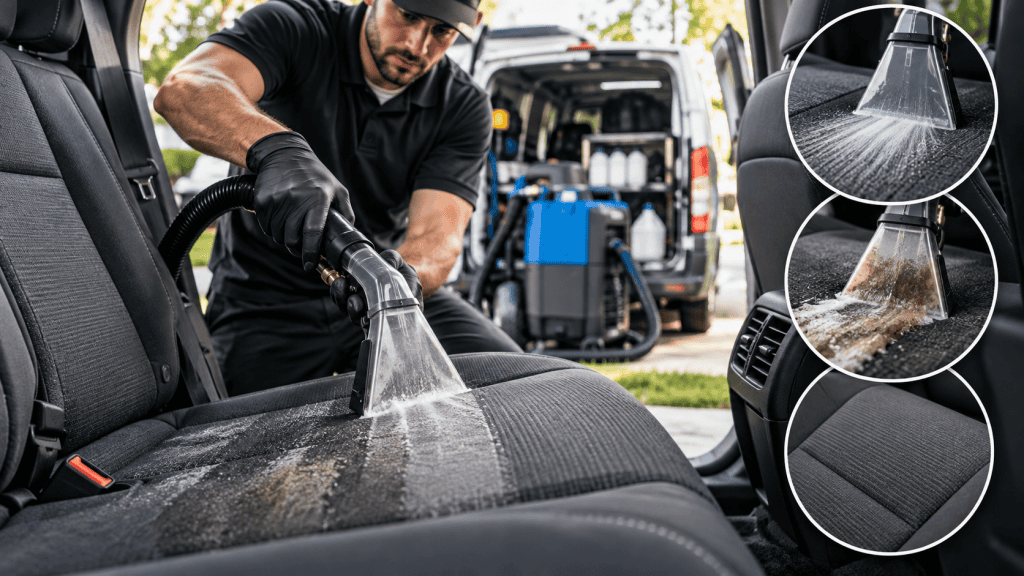

Hot-water extraction cleans compatible automotive carpet and cloth upholstery by applying controlled cleaning solution, loosening soil and recovering contaminated moisture through a vacuum tool. The method succeeds through material testing, dry removal, pretreatment, controlled rinsing, recovery-only passes and drying—not through maximum heat or saturation.
Solution volume follows textile construction and contamination.
Vacuum lift removes suspended soil and moisture through the tool.
Recovery passes, airflow, humidity and material depth affect drying.
What Is Hot-Water Extraction in Car Detailing?
Hot-water extraction is a wet-cleaning method for suitable automotive textiles. A detailing extractor uses a solution line to deliver water or cleaning solution through an upholstery tool and a vacuum channel to pull liquid back into a recovery tank. The liquid entering the fabric and the recovered liquid leaving it are therefore parts of one controlled cleaning cycle.
The word hot describes heated or warm solution where the material, chemical and equipment permit it. It does not mean every fabric should receive the machine’s highest available temperature. Heat is one variable alongside chemistry, agitation, dwell time, liquid volume and vacuum recovery.
An extractor should be understood by its functions. It stores or receives cleaning solution, pumps it to the tool, applies it over a bounded area and uses vacuum lift and airflow to recover moisture and suspended contamination. Our comparison of vacuums, extractors and steam cleaners explains what each machine contributes.
How Does the Hot-Water Extraction Process Work?
Professional extraction is a sequence, not a single pass with a wet tool. Skipping dry cleaning, testing or recovery can redistribute soil, leave detergent behind or add more moisture than the material can release efficiently.
1. The detailer identifies the material and condition
The first decision is whether the surface is a suitable candidate. Automotive interiors can combine face fabric, foam, backing, adhesive, seams, electrical components and occupancy sensors within one seat assembly. Carpet may sit above padding, wiring or electronic modules. The visible textile does not reveal every moisture-sensitive component below it.
The technician checks construction, color stability, previous damage and contamination. A small compatibility test can reveal color transfer, texture change or an unexpected reaction before a larger area is treated. This material-first logic also governs the broader selection of mobile-detailing cleaning methods.
2. Dry debris is removed before liquid is introduced
Sand, crumbs, hair and loose particulate matter should be vacuumed before wet cleaning. Adding liquid too early can turn removable dry soil into slurry and move it farther into fibers, seams or carpet edges. Crevices, seat tracks and pile direction may require different nozzles or brush work.
3. A compatible pretreatment is applied
Pretreatment places cleaning chemistry where it is needed before the rinse-and-recovery passes. Product and dilution must match the surface and contamination rather than being selected only for strength. Oily residue, food, road salt and water-based spills do not respond identically.
The cleaner receives controlled contact time so it can help release soil, but dwell time does not mean allowing it to dry. Overapplication increases the rinsing and recovery required later.
4. Agitation helps separate soil from the textile
A brush, towel or suitable mechanical tool can distribute pretreatment and loosen soil from the fiber structure. Agitation must match the textile: aggressive brushing can fuzz delicate fabric, alter pile direction or abrade a weakened area.
Agitation and extraction perform different tasks. Agitation loosens and distributes; extraction removes suspended contamination and moisture. Neither substitutes for the other.
5. The extraction tool delivers and recovers liquid
The technician moves the upholstery tool in controlled, overlapping passes. When the solution trigger is used, liquid is delivered near the vacuum opening. The recovery channel then draws moisture, dissolved cleaner and suspended soil toward the recovery tank.
Technique changes how much moisture remains. Moving too quickly may provide insufficient cleaning contact. Moving too slowly, repeatedly triggering over one area or losing tool contact can increase saturation. Edges, seams and heavily padded zones require restraint because liquid can travel beyond the visible treatment area.
6. Dry recovery passes remove additional moisture
After rinse passes, the technician repeats the movement without dispensing more solution. These dry passes matter because cleaning is not complete when a surface merely looks evenly wet; it is complete after practical recovery and an appropriate drying plan.
Dark recovery water may provide useful feedback, but it does not prove the textile is fully clean. Dye, previous product residue and deeply held soil can change its appearance. Evaluation should focus on the material after recovery and drying—not a photograph of wastewater.
Which Vehicle Surfaces Can Be Extracted?
| Surface | Potential use | Main limitation |
|---|---|---|
| Automotive carpet | Rinsing compatible fibers after dry removal and pretreatment | Padding, wiring and modules may be below it |
| Removable carpet mats | Better access for cleaning and drying | Backing and color stability still require inspection |
| Compatible cloth seats | Controlled cleaning of soil held in fabric | Foam, seams, sensors and heaters limit moisture |
| Headliners | Usually not a routine extraction surface | Moisture and agitation can affect adhesive-backed construction |
| Leather or coated trim | Normally uses a material-specific surface method | Extraction is intended for suitable textiles |
Material compatibility determines the method. See how different automotive interior materials are cleaned for the distinction between textile extraction and procedures for leather, plastics, screens and adhesive-backed components.
Is Extraction the Same as Shampooing or Steam Cleaning?
No. These terms are often used loosely, but they describe different functions.
- Vacuuming removes loose dry debris and does not rinse a textile.
- Shampooing usually means applying and agitating detergent; the word alone does not establish how residue is removed.
- Hot-water extraction applies controlled liquid and uses vacuum recovery to remove part of that liquid with suspended soil.
- Vapor steam cleaning uses heated vapor for surface-specific cleaning and does not flush carpet or upholstery like an extractor.
One appointment may use several methods because a cabin contains different materials and contamination types. See how steam cleaning works in mobile detailing for the separate heat, vapor and surface-sensitivity relationship.
Why Can Too Much Water Cause Problems?
Excess liquid can move below the textile face into foam, padding, seams or backing. That can extend drying time, mobilize old contamination, leave water marks or contribute to an odor returning as the cabin warms. Dissolved residue can also migrate upward during drying and become visible again—a process commonly called wicking.
The U.S. Environmental Protection Agency advises drying wet or damp materials within 24–48 hours in its mold and moisture guidance. This is general building guidance, not a vehicle-specific guarantee, but it reinforces the underlying rule: recover unnecessary water and begin drying promptly.
Good technique aims for sufficient cleaning action with the least practical retained moisture—not maximum saturation. More liquid does not automatically mean more cleaning.
How Long Does a Car Interior Take to Dry After Extraction?
There is no universal drying time. It changes with retained liquid, textile thickness, seat foam, carpet padding, airflow, humidity, temperature and whether mats can be removed. Northeast Ohio weather can make the same procedure dry differently on a warm, low-humidity day than during cold or humid conditions.
After service, airflow and ventilation should continue when conditions safely allow. Windows should not be left open where rain, security or outdoor humidity creates another problem. Customers should follow condition-specific instructions rather than assuming a surface that feels dry on top is dry through its full construction.
Can Extraction Remove Every Stain or Odor?
No. Extraction is a cleaning mechanism, not a guarantee of total stain or odor removal. Results depend on the contaminant, material, age, previous treatments and how far the source traveled.
A stain may have changed the fiber or dye. An odor may originate below the surface in seat foam, carpet padding or an air pathway. Repeatedly wetting the visible area can make the source harder to diagnose. Those outcomes require separate stain and odor evaluations.
When Is Hot-Water Extraction Appropriate?
Extraction is most useful when compatible carpet or cloth upholstery holds contamination that remains after dry removal and controlled surface cleaning. It may be unnecessary for light dust, nonporous trim or a maintenance appointment where a lower-moisture method can achieve the agreed result.
The booking label alone does not guarantee extraction. Package scope, vehicle condition, material testing and inspection determine the suitable processes. Review what mobile car detailing can include, then use Nathan’s current package description for exact commercial inclusions.
Need Deep Interior Cleaning at Your Home or Workplace?
Nathan’s Detailing serves Cleveland, Akron and communities across Northeast Ohio with self-contained mobile units. We inspect each vehicle and choose methods according to its materials, condition and booked service—not a one-method-fits-all template.
View mobile car detailing packages or check the mobile service area.