

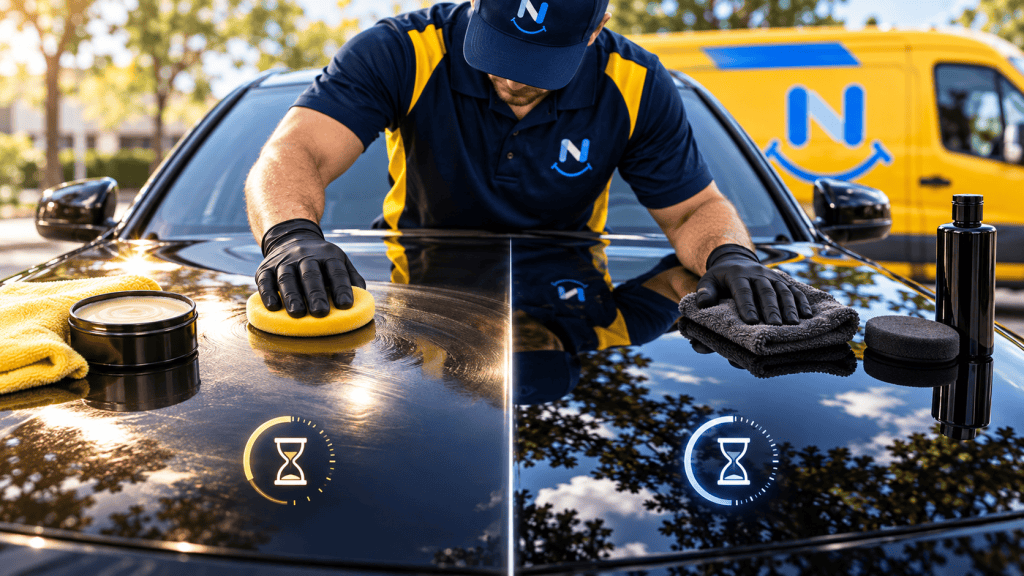

Car wax and paint-sealant durability is not controlled by the calendar alone. The installed product sets the starting potential, then surface preparation, washing, mileage, weather, contamination and parking conditions determine how quickly that protection is consumed. In our current mobile service, Premium wax is advertised for up to 3 months. As a named synthetic-sealant benchmark, SONAX Polymer Net Shield is advertised for up to 6 months. Neither number is a guarantee for every vehicle because exposure can shorten real-world performance.
Why does the same wax last three months on one car and much less on another?
Protection has two kinds of age: calendar age and exposure age.
Calendar age is simply how many days have passed since application. Exposure age is how much real work the protective layer has done during those days: highway miles, rain, snow, road salt, sun, detergent, repeated washing, bug residue, outdoor parking and contamination cycles.
A garaged vehicle driven 2,000 miles over three months is not experiencing the same protection load as an outdoor-parked daily driver covering 7,500 miles through Northeast Ohio winter weather. The calendar can be identical while the exposure history is completely different.
That is why our wax vs. paint sealant comparison treats durability as a product-specific service attribute rather than a universal category number.
Starting potential
The product formulation, film left behind and manufacturer/service claim establish the protection’s starting window.
Exposure load
Mileage, outdoor parking, weather, road contamination and wash frequency consume that window at different rates.
Maintenance quality
Compatible washing can preserve useful behavior; harsh chemistry or abrasive washing can shorten it.
What is the realistic durability difference between wax and paint sealant?
The most accurate comparison uses named products rather than generic internet ranges.
| Protection example | Category | Published term | What the number actually means |
|---|---|---|---|
| Our current Premium Complete protection | Premium wax | Up to 3 months | Our current mobile-service upper claim under suitable use and maintenance; not a guarantee for every vehicle. |
| SONAX Polymer Net Shield | Wax-free synthetic polymer sealant | Up to 6 months | A named manufacturer sealant example; it does not mean all sealants last six months. |
| Our Platinum Complete protection | Ceramic wax | Up to 9 months | A different hybrid protection category showing that modern wax-labelled products can overlap or exceed sealant intervals. |
| Our XPEL studio coatings | Professional ceramic coating | 2-, 5- or 8-year packages | A separate coating system with different preparation, curing and maintenance requirements. |
Our guide to protection products used after mobile detailing maps these categories to their compatible surfaces and service roles.
Which six variables control protection durability the most?
| Variable | Lower durability load | Higher durability load | Mechanism |
|---|---|---|---|
| 1. Product type | Named product with longer verified service term | Shorter-term product or unknown formulation | Different formulations leave different protective films and maintenance requirements. |
| 2. Surface preparation | Clean, decontaminated, compatible paint | Residual traffic film, old product or bonded contamination | Preparation affects what the protection is actually being applied over. |
| 3. Washing method | Compatible detergent, clean tools, controlled contact | Strong degreasers, repeated harsh chemistry, abrasive contact | Cleaning can remove or mechanically wear temporary protective material. |
| 4. Mileage | Lower mileage / lower road exposure | High daily mileage / frequent highway use | More miles create more cycles of dirt, water, insects, spray and cleaning. |
| 5. Weather | Mild, dry exposure | Rain, snow, freeze-thaw, road salt, strong sun and temperature cycling | Weather changes contamination load and how often the surface must be cleaned. |
| 6. Parking | Garage or protected structure | 24/7 outdoor parking | Outdoor storage increases UV, rain, dew, tree fallout, bird contamination and temperature exposure. |
Why does surface preparation change how long protection lasts?
A protection product is applied to the surface condition that preparation leaves behind. If washable dirt, traffic film, bonded contamination or incompatible old product remains, the new layer may not interact with the paint exactly as intended.
This is why preparation is a separate stage in our mobile detailing process. Washing removes loose soil; decontamination addresses material that remains attached; polishing refines eligible paint defects; protection then goes over the resulting surface.
| Paint condition before protection | Likely durability implication | Correct response |
|---|---|---|
| Clean, smooth paint | Good starting condition for compatible wax/sealant application | Apply according to product instructions. |
| Residual road film | Protection may be applied over contamination rather than the intended substrate | Improve cleaning before protection. |
| Bonded contamination | Roughness and contamination remain beneath the protection | Use appropriate decontamination when included/needed. |
| Old incompatible protection | Can affect the behavior of the new layer | Follow the new product’s preparation requirements. |
| Oxidized or failing paint | Protection cannot restore failed paint structure | Assess correction or repair before relying on protection. |
How does washing shorten—or preserve—wax and sealant life?
Every wash is a maintenance event. It can remove contamination while preserving the protection, or it can add chemical and mechanical load that shortens the protection’s useful behavior.
Repeated strong degreasers, aggressive pre-washes, contaminated wash media and unnecessary scrubbing can all increase that load. A compatible wash process uses enough cleaning power to remove soil without treating every maintenance wash like a stripping procedure.
Our article on mobile detailing cleaning methods explains why chemistry, agitation and recovery should be matched to the actual contamination rather than maximized automatically.
Does washing more often always make protection fail faster?
No. Frequency alone is not the whole variable.
A carefully maintained vehicle washed weekly with compatible chemistry may preserve its finish better than a vehicle washed monthly with a harsh degreaser and dirty brush. Conversely, an outdoor car allowed to accumulate road salt, insect residue, bird contamination or tree fallout for long periods can create different risks even if it is “washed less.”
How does mileage affect wax and sealant durability?
Mileage is not chemically consuming protection by itself. It is a useful proxy for road-exposure cycles.
More miles can mean more rain spray, dust, insects, tire film, road salt, construction debris and highway contamination. More contamination often means more frequent or more intensive washing, which adds another exposure cycle.
| Driving pattern | Typical exposure pattern | Durability implication |
|---|---|---|
| Low-mileage garage vehicle | Limited road film, fewer wash cycles, protected storage | May remain closer to the product’s advertised upper window. |
| Daily suburban commuter | Regular rain/dust exposure and routine washes | Moderate protection consumption. |
| Highway-heavy commuter | More insects, spray, grime and high-speed contamination | Can require more cleaning and shorten observable performance. |
| Commercial / high-use vehicle | High miles, repeated washing, continuous environmental exposure | Calendar-based durability expectations become less useful. |
Why does Northeast Ohio weather matter?
Our service area is not a mild, dry laboratory environment. Cleveland’s 1991–2020 climate normals published by the National Weather Service show about 41.03 inches of precipitation and 63.8 inches of snowfall in a normal year.
Those figures do not tell us exactly how many days a wax will last. They show why a Northeast Ohio vehicle can experience repeated wetting, snow, winter road film, freeze-thaw cycles and wash events over a protection interval.
| Environmental load | What it changes | Durability relevance |
|---|---|---|
| Rain / repeated wetting | Moves road contamination, minerals and organic material over the surface | Can increase washing frequency and make beading behavior harder to interpret when the paint is dirty. |
| Snow / winter road film | Adds slush, salt-related residue and dirty spray | Raises cleaning demand during the protection interval. |
| Summer sun | Raises surface temperature and UV exposure | Outdoor weathering affects automotive coating systems and increases environmental load on exposed surfaces. |
| Freeze-thaw cycles | Repeated temperature and moisture changes | Increase the seasonal variability a daily driver experiences. |
| Tree / biological fallout | Sap, pollen, bird contamination and organic deposits | Can require prompt cleaning rather than waiting for the next scheduled wash. |
How much difference does garage parking make?
Garage parking reduces several exposure categories simultaneously: direct sun, overnight dew, rain, snow, bird contamination, tree fallout and daily temperature swings.
It does not make protection permanent. Driving still exposes the vehicle to the road, and washing still creates maintenance cycles. But protected storage can help a vehicle remain closer to the upper end of an advertised product window than continuous outdoor parking under otherwise similar use.
Why is outdoor parking more than a UV problem?
Outdoor parking is often discussed only as “sun exposure,” but the vehicle is also exposed while it is not moving.
Rain can dry on the paint. Pollen and dust can accumulate between washes. Birds and trees can deposit contamination. Dew repeatedly wets the surface. Winter precipitation and wind-blown road residue can reach the parked car.
The combined exposure history is why parking environment belongs next to mileage and wash method in a durability assessment.
Does water stop beading when wax or sealant is dead?
Not necessarily. Water behavior is useful, but beading alone is not a complete durability test.
A dirty protective surface can temporarily bead or sheet differently because road film and surfactant residue change the surface behavior. A freshly washed but unprotected panel can also show some beading depending on the paint and cleaner.
| Observation | Possible interpretation | What to do next |
|---|---|---|
| Beading became weaker | Protection may be declining, or contamination may be masking behavior | Wash properly, rinse fully and reevaluate on a clean panel. |
| Surface feels less slick | Protection may be wearing or contamination may be accumulating | Do not diagnose by feel alone; inspect cleanliness and water behavior together. |
| Water remains flat after a proper wash | Protection may be substantially reduced | Compare with known behavior after application and consider renewal. |
| Paint is rough | Bonded contamination may have accumulated | Do not assume the only problem is expired wax; assess contamination separately. |
| Gloss looks lower | Could reflect dirt, wash marring, oxidation, contamination or reduced protection | Inspect the paint condition before simply applying more product. |
What is the most useful durability model for a real vehicle?
A useful way to think about protection life is to look at what helps it last and what makes it work harder:
The “up to” number on a product or service gives you a useful reference point, but the way the vehicle is used and maintained determines where it actually lands within that window.
How can you estimate whether your protection will be near the short or long end of its window?
The table below shows how different real-world vehicle-use patterns can change where protection is likely to fall within its advertised service window.
| Vehicle profile | Parking | Mileage | Wash / exposure pattern | Expected position within product window |
|---|---|---|---|---|
| Protected-use vehicle | Mostly garaged | Low | Gentle maintenance, limited severe-weather use | More likely to remain toward the longer end. |
| Normal daily driver | Mixed garage / outdoor | Moderate | Routine commuting and compatible washing | Mid-window is a reasonable inspection point. |
| High-exposure commuter | Mostly outdoor | High | Frequent highway use, rain/salt cycles, frequent washing | Inspect earlier; protection may decline before the advertised upper limit. |
| Severe-use vehicle | Outdoor | Very high / commercial | Repeated harsh contamination or strong wash chemistry | Calendar claims become less predictive; condition-based maintenance matters more. |
What can you do to make wax or sealant last longer?
- Apply the product only after the paint has been cleaned and prepared to the level required by that product.
- Use the application amount, dwell time and removal method specified for the exact product.
- Avoid repeatedly using strong degreasers when ordinary maintenance chemistry can remove the contamination.
- Use clean wash media and controlled contact instead of aggressive scrubbing.
- Remove bird droppings, bug residue, sap and winter road film promptly rather than allowing contamination to remain indefinitely.
- Use protected parking when available.
- Evaluate the surface after a proper wash instead of judging durability while the paint is dirty.
- Do not stack unknown or incompatible products simply to chase more beading.
- Renew the protection when its behavior and the product instructions indicate it is time.
If the desired maintenance interval has outgrown temporary wax or sealant, compare the service process rather than continuously layering stronger temporary products. Our professional ceramic coating options are the appropriate next context for customers looking for a multi-year system.
How do we set durability expectations after a mobile detail?
We separate the published upper term from the vehicle’s real exposure profile.
For our current Premium Complete mobile detail, the first-party claim is Premium wax protection up to three months. We do not promise that every vehicle will show identical beading or slickness on day 90 because a garaged weekend vehicle and an outdoor daily driver can accumulate very different exposure during the same period.
We also do not use a generic sealant lifespan as if it were one of our current package claims. Our wax vs. sealant article explains the category difference, while this durability guide explains why even a named product’s maximum term can change in the real world.
For a complete service context, our mobile detailing packages show the protection currently included at each level, while our mobile detailing process guide explains how cleaning, preparation and protection fit together.
Want protection matched to how you actually use your vehicle?
Tell us where the vehicle is parked, how many miles you drive, how often it is washed and whether it sees Northeast Ohio winter use. We can match the detailing and protection conversation to the vehicle’s real exposure instead of relying on a generic calendar number.
Explore Mobile Car DetailingEvidence and service references
[1] Nathan’s Detailing — Mobile Car Detailing. Our current Premium Complete package includes Premium wax advertised for up to three months. Our Platinum Complete package includes ceramic wax advertised for up to nine months after a more intensive preparation sequence.
[2] Nathan’s Detailing — What Does Mobile Car Detailing Include? Separates washing, decontamination, polishing and protection as different exterior-detailing stages and states that wax/sealant durability depends on the product and conditions.
[3] Nathan’s Detailing — Car Wax vs Paint Sealant. Explains composition, application, appearance, durability and maintenance differences without treating “wax” and “sealant” as universal formulas.
[4] SONAX — PROFILINE Polymer Net Shield. SONAX identifies Polymer Net Shield as a wax-free polymer paint sealant offering protection for up to six months and specifies application to clean, dry paint.
[5] Meguiar’s — Professional M21 Synthetic Sealant 2.0. Meguiar’s identifies M21 as a synthetic polymer formulation with hydrophobic behavior, gloss and water beading, illustrating the synthetic sealant category.
[6] National Weather Service Cleveland — 1991–2020 Climate Normals. Cleveland normals list approximately 41.03 inches of annual precipitation and 63.8 inches of annual snowfall, providing local environmental context for Northeast Ohio vehicle exposure.
[7] Automotive-coating weathering literature. Published automotive-coating research shows that outdoor weathering, UV exposure and environmental ageing affect automotive clearcoat chemistry and performance. These studies support exposure as a real paint-system variable but do not provide a direct conversion from weather to wax/sealant lifespan.
Advertised durability is product-specific. Our current service description and the exact product instructions control if they differ from general educational examples.