
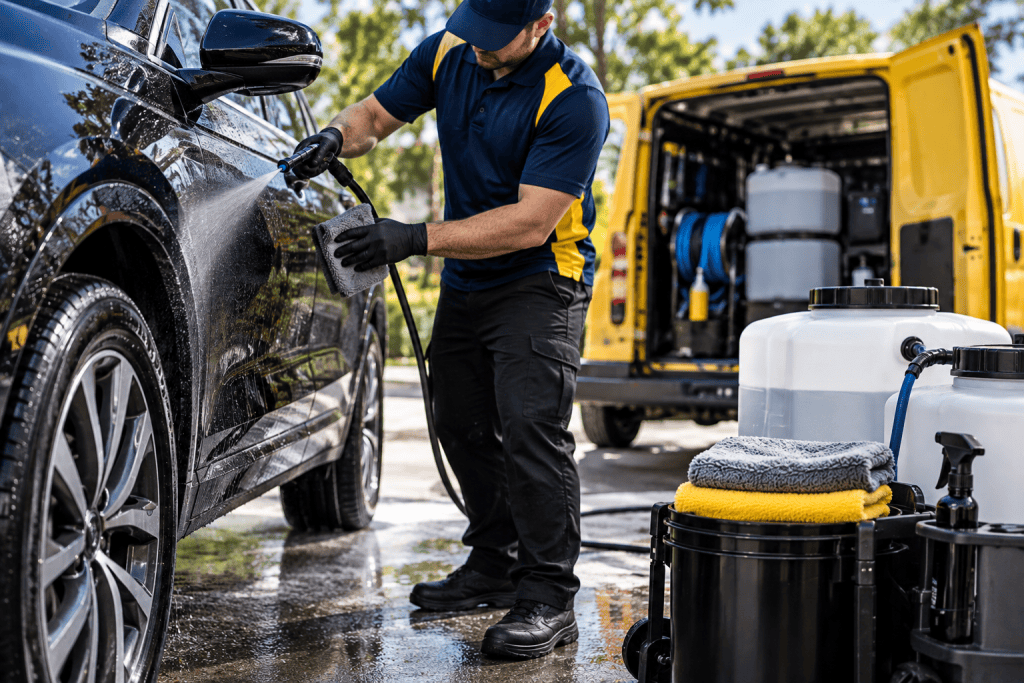

There is no single gallon figure that applies to every mobile car detail. Water use changes with the wash method, vehicle size, contamination level, wheel and tire condition, whether a separate rinse is needed, and whether interior extraction or other wet processes are included. Our mobile units carry their own water and power, but we do not currently publish a measured gallons-per-vehicle figure or tank capacity, so we do not invent one. A lightly contaminated vehicle cleaned with a rinseless process can require far less water than a heavily soiled SUV that needs pre-rinsing, wheel flushing and additional wet cleaning.
Why is there no honest “one number” for mobile detailing water use?
A mobile detailing appointment is not one continuous hose cycle. It is a group of separate cleaning processes, and each process can use a different amount of water.
An exterior wash may use a conventional rinse process, a low-water method or a rinseless process. Wheel barrels may need more flushing than lightly dusty body panels. A three-row SUV has more exterior area than a coupe. Heavy mud or winter road salt may require pre-rinsing before safe contact washing. Interior carpet extraction introduces and recovers cleaning solution separately from the exterior wash.
That means total appointment water is better understood as:
The exact combination changes with the booked package and the vehicle. Our guide to what mobile car detailing includes explains why the task list should be identified before trying to estimate resources.
What do we currently confirm about our mobile water setup?
Our mobile units are self-contained. We bring water, onboard power and professional detailing equipment to approved homes, workplaces and customer locations throughout Northeast Ohio.
This means a normal approved appointment does not depend on the customer supplying a garden hose or electrical outlet. We still evaluate access, weather, drainage, runoff and the booked work before confirming that a location is suitable.
| What we currently confirm | What we do not currently publish | Why that distinction matters |
|---|---|---|
| Our mobile units carry water | A public tank-capacity figure | We should not infer tank size from the fact that the unit is self-contained. |
| We bring onboard power | One fixed equipment load for every appointment | Different packages require different tools. |
| We can work without normal customer hookups | A fixed gallons-per-vehicle promise | Water use changes with method, size and contamination. |
| We evaluate runoff and site conditions | One drainage rule for every property | Parking surfaces and local requirements differ. |
How does the wash method change water use?
The wash method is usually the biggest exterior-water variable because it determines whether the process includes a separate rinse stage.
| Wash method | How water is used | Separate hose rinse? | When it may fit | What can increase water use |
|---|---|---|---|---|
| Conventional rinse wash | Pre-rinse, wash solution, contact wash and final rinse | Yes | Vehicles where loose contamination should be flushed before or after contact | Long rinse time, larger vehicle, heavy wheels, mud or salt |
| Low-water wash | Controlled spray/solution with limited rinsing | Sometimes limited | Moderate contamination when the selected products and conditions support it | Extra pre-rinse or repeated sections |
| Rinseless wash | Wash solution is applied and then dried without a separate hose-rinse stage | No final hose rinse | Suitable contamination levels and compatible products | Pre-rinse for grit, second wash, wheels, extra solution or heavily soiled areas |
| Waterless spot cleaning | Product is applied directly in a small controlled area | No | Light, localized contamination when the product permits it | Not appropriate as a substitute for safely removing heavy abrasive soil |
How much water can a rinseless wash use?
Rinseless water use must be tied to the product instructions and the actual vehicle rather than treated as one industry-wide number.
As a current manufacturer example, Optimum No Rinse Wash & Shine V6 instructs users to mix 1 ounce of product into 2 gallons of water for the wash solution. The manufacturer also states that no hose or traditional final rinse is required.
That 2-gallon bucket is a product-mixing example—not a claim that every complete mobile detail uses only two gallons. A heavily soiled vehicle may need a pre-rinse or second wash, and separate wheel cleaning, towel rinsing, interior extraction or other tasks can add water.
Our mobile detailing process guide explains why the selected method can change when the actual contamination is inspected on arrival.
How does vehicle size change water use?
Vehicle size changes the amount of exterior surface area, wheel size, glass area and the number of panels that need to be cleaned.
We currently classify most coupes, convertibles and four-door sedans as small; most crossovers, small trucks and small SUVs as medium; and most three-row vehicles, large trucks, SUVs and minivans as large.
A larger vehicle can require more wash solution and rinse coverage simply because more surface exists. But size is not the only variable: a clean large SUV can sometimes require less intensive washing than a small car covered in dried mud or road salt.
Why does contamination level sometimes matter more than vehicle size?
Water is not used only to make the surface wet. It is used to safely move contamination away from the vehicle.
Loose dust on a protected vehicle and packed winter salt in a wheel barrel are different cleaning problems. Heavy mud can contain abrasive grit that should be removed before contact. Road salt may require more flushing than light summer dust. Bug residue can need localized treatment rather than simply more water everywhere.
| Condition | Likely water effect | Why |
|---|---|---|
| Light maintenance dust | Lower | May support low-water or rinseless methods when the surface and product are suitable. |
| Normal road film | Moderate | Requires enough solution and recovery to safely remove attached contamination. |
| Heavy wheel brake dust | Higher in wheel zones | Wheel faces, lug areas and barrels may need dedicated chemistry, agitation and thorough rinsing. |
| Winter road salt | Potentially higher | Salt and dirty spray can require more pre-rinse and flushing before safe contact washing. |
| Mud / gritty contamination | Potentially higher | Abrasive material should be removed rather than dragged across the finish. |
| Localized bug residue | Localized increase | Targeted pretreatment may be more useful than increasing water over the whole vehicle. |
Our article on wheels, tires and exterior glass shows why some exterior zones need different chemistry, tools and rinse behavior even during the same appointment.
Does interior detailing use water too?
Yes, when the booked interior work includes wet cleaning. Interior water use is separate from the exterior wash.
Vacuuming loose debris uses no cleaning water. Damp wiping uses a small controlled amount. Carpet or upholstery extraction uses cleaning solution and then recovers moisture and suspended contamination into a separate recovery tank.
One equipment example already documented in our mobile-detailing guide is the Mytee 8070 extractor, which has separate 4-gallon solution and 4-gallon recovery tanks. Those are machine capacities—not proof that every interior appointment consumes four gallons.
Why does extractor tank size not equal water used?
A tank tells us what the machine can hold. It does not tell us how much solution is actually delivered into one vehicle.
Actual use depends on the material being treated, number of seats or carpeted areas, soil level, number of passes, recovery efficiency and whether the tank is refilled.
How does a self-contained water tank change mobile detailing?
Onboard water changes where the water comes from. It does not determine one fixed amount of water for every job.
Our self-contained units let us arrive with water and power already available. That makes approved homes, workplaces and other locations practical without normally requiring customer hookups. We still need enough safe working space and a location where water and residue can be managed appropriately.
How does mobile detailing compare with commercial car-wash water figures?
Commercial car-wash figures can provide context, but they should not be used as if they were Nathan’s mobile-detailing measurements.
The U.S. EPA’s WaterSense guidance uses method-specific benchmarks for commercial vehicle washes. Current EPA guidance discusses freshwater thresholds in the range of roughly 35–40 gallons per vehicle for certain conveyor and in-bay automatic systems, and recommends self-service nozzles flow at no more than 3 gallons per minute.
Those figures show why method matters: water use is affected by system design, flow rate, cycle length and whether water is reclaimed. They do not mean our mobile details use 35, 40 or any other specific number of gallons.
Why does runoff matter as much as the amount of water?
Water use is only one part of responsible vehicle washing. The used water can carry whatever the cleaning process removes from the vehicle.
The U.S. EPA notes that vehicle wash water can contain oil, grease, metals, phosphates, detergents, soaps, cleaners and road salts. EPA guidance also warns that water washing from pavement into storm drains can reach local waterways without treatment.
This is why we evaluate the site, drainage and runoff conditions rather than assuming every driveway or parking lot should be treated identically.
Source
Where the clean water comes from: onboard tank or another approved supply.
Use
How the selected wash, wheel and interior-cleaning processes consume that water.
Destination
Where rinse water, residue and recovered dirty solution go after cleaning.
Can you estimate water use before seeing the vehicle?
You can estimate the likely direction of water demand, but not a reliable gallon total from the vehicle model alone.
| Vehicle / condition example | Likely water demand | Main reason |
|---|---|---|
| Maintained sedan with light dust | Lower | Smaller area and possible low-water/rinseless compatibility. |
| Maintained three-row SUV | Moderate | More exterior area even if contamination is light. |
| Small car with dried mud | Higher than size suggests | Grit may require safe pre-rinsing and extra flushing. |
| Large winter-driven SUV | Higher | Large area plus salt, wheel contamination and repeated rinsing needs. |
| Interior-only vacuum/reset | Very low | Most work is dry unless damp wiping or wet treatment is needed. |
| Interior with extensive extraction | Higher interior water use | Cleaning solution is delivered and recovered from compatible textiles. |
Does using less water always mean a better detail?
No. Efficient water use is valuable, but the safest process is the one that removes contamination without creating unnecessary abrasion, residue or runoff.
Using too little water on heavy gritty contamination can be a false economy if the process drags abrasive soil across the paint. Using excessive rinse water on a lightly dusty vehicle can also be unnecessary when a compatible low-water method would perform the job safely.
The correct goal is enough water for the selected method and contamination—without using more than the process needs.
How can water use be reduced without compromising the vehicle?
- Inspect contamination before choosing the wash method.
- Use rinseless or low-water methods only when the contamination and product instructions support them.
- Target pre-rinsing to gritty or heavily contaminated areas instead of flooding clean panels unnecessarily.
- Shut off water flow while agitating wheels or other areas when continuous flow is not needed.
- Use appropriate nozzles, pumps and pressure settings rather than uncontrolled open flow.
- Keep vehicles maintained so contamination does not repeatedly build into heavy soil loads.
- Use product dilution ratios exactly as instructed rather than compensating for weak technique with excess product or water.
- Separate interior extraction from ordinary damp wiping so wet equipment is used only where it adds value.
- Plan runoff and wastewater handling before starting the wash.
How do we handle water during our mobile appointments?
We arrive with a self-contained mobile setup that includes water, power and the professional equipment selected for the booked service. We then match the wash method to the vehicle’s actual condition, size, existing protection, weather and location.
A lightly contaminated maintenance vehicle does not automatically receive the same water process as a winter-driven SUV with packed wheel contamination. Likewise, a vacuum-focused interior appointment does not create the same water demand as one requiring textile extraction.
For customers comparing the complete service, our mobile car detailing packages show what is included, while our mobile detailing guide explains how our self-contained setup works at approved homes and workplaces. Our service-area page also explains where we bring our onboard water and equipment throughout Northeast Ohio.
Need mobile detailing without normal water or power hookups?
Our self-contained units bring water, onboard power and professional equipment to approved locations. Tell us your vehicle size, condition and parking setup so we can confirm the appropriate mobile process before the appointment.
Explore Mobile Car DetailingEvidence and service references
[1] Nathan’s Detailing — What Is Mobile Car Detailing and How Does It Work? Our current guide states that our self-contained mobile units carry water, onboard power and professional equipment. It also explains that conventional washing normally includes a separate rinse stage, while rinseless washing removes that separate rinse stage and may still require more preparation for heavy contamination.
[2] Nathan’s Detailing — Mobile Car Detailing. Our current service page states that we bring power, water, equipment and expertise and classifies vehicles as small, medium and large for mobile-service planning.
[3] Nathan’s Detailing — What Is Included in Mobile Car Detailing? Explains that vehicle size changes surface area and resource demand, while condition changes treatment intensity. It also identifies wash method, contamination and operating environment as process variables.
[4] Optimum Polymer Technologies / Opti-Coat — Optimum No Rinse Wash & Shine V6. Current manufacturer directions specify 1 ounce of product to 2 gallons of water for the rinseless wash solution and state that no traditional hose rinse is required. The manufacturer also notes that heavily soiled vehicles may require a pre-rinse or second wash.
[5] U.S. EPA — WaterSense at Work: Vehicle Washes. EPA guidance uses different freshwater thresholds and flow-rate criteria for different commercial wash-system types, illustrating that water use depends on equipment and wash method. These figures are not Nathan’s mobile-detailing measurements.
[6] U.S. EPA — Vehicle Maintenance and Washing / Source Water Protection Guidance. EPA identifies oil, grease, metals, phosphates, detergents, soaps, cleaners and road salts as possible components of vehicle wash water and recommends preventing contaminated runoff from reaching storm drains and surface waters without appropriate management.
[7] Nathan’s Detailing — Terms and Conditions. Our current mobile-service terms require a lawful, safe and reasonably suitable work location and note that some unexpected conditions may require access to customer-provided utilities, which would be discussed before work begins.
We do not currently publish a measured Nathan’s gallons-per-vehicle figure or mobile water-tank capacity. If those measurements are published in the future, they should replace any generic estimate.