

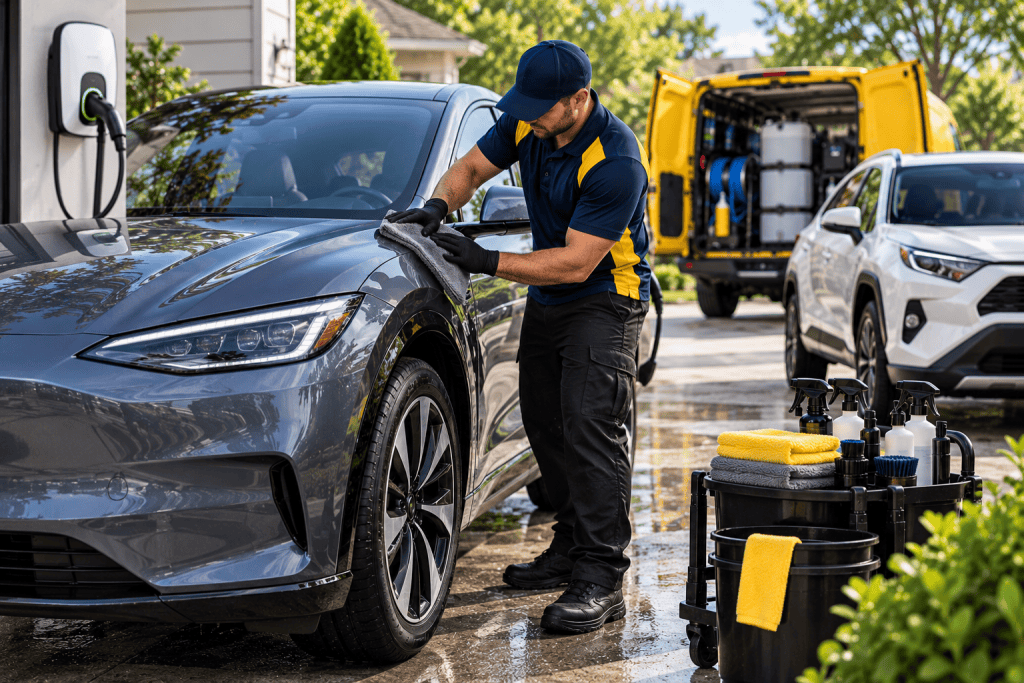

Yes. Routine mobile detailing can be performed safely on electric and hybrid vehicles when the vehicle manufacturer’s precautions are followed. Washing paint, cleaning wheels and glass, vacuuming carpets and cleaning seats are largely the same tasks used on other vehicles. Additional care is needed around charge ports, cameras and sensors, touchscreens, high-voltage warning labels, exposed electrical components and any orange high-voltage cables. The vehicle should not be actively charging during exterior washing, liquid should be controlled around electronics, and ordinary detailing should never involve removing high-voltage covers or touching service plugs, orange cables or damaged electrical components.
What stays the same when detailing an EV or hybrid?
An EV does not require a completely different detailing system. Most of the vehicle is still made of familiar automotive surfaces: clear-coated paint, glass, wheels, tires, carpet, upholstery, plastic trim and display surfaces.
The same basic rule applies that we use throughout our mobile detailing process: identify the material, identify the contamination, choose compatible chemistry and tools, control moisture and inspect the finished result.
| Detailing task | EV / hybrid | Gasoline vehicle | Main consideration |
|---|---|---|---|
| Paint washing | Normal exterior-care principles apply | Normal exterior-care principles apply | Follow the specific vehicle’s pressure, chemistry and wash-mode instructions. |
| Wheel / tire cleaning | Material-compatible wheel and tire process | Material-compatible wheel and tire process | Wheel finish and contamination determine chemistry—not the powertrain. |
| Glass cleaning | Normal glass cleaning with camera/sensor awareness | Normal glass cleaning with camera/sensor awareness | Do not compromise cameras or manufacturer-restricted glass treatments. |
| Vacuuming | Normal cabin vacuuming | Normal cabin vacuuming | Do not disturb electrical access covers or service panels. |
| Seat / carpet cleaning | Material-specific process | Material-specific process | Control moisture and avoid saturating electronics, connectors or mechanisms. |
| Touchscreen cleaning | Often especially important because major controls may be display-based | Increasingly common on all modern vehicles | Use manufacturer-compatible cloth, chemistry and liquid placement. |
Which areas need extra care on an electric or hybrid vehicle?
Charge port
Keep high-pressure water away from the inlet, especially while charging, and follow the model’s wash-mode/port-door instructions.
High-voltage system
Orange cables, high-voltage labels, service plugs and electrical covers are not detailing targets and should never be opened or disturbed.
Cameras + displays
Use controlled liquid and manufacturer-compatible cleaning around sensors, cameras, screens, switches and electronic seams.
How should the charging port be handled during detailing?
The charge port deserves a simple rule: keep exterior washing separate from active charging.
Tesla’s current Model 3 guidance says Car Wash Mode requires the vehicle to be stationary and not actively charging. The mode closes windows, locks the charge port and disables functions such as automatic wipers that could interfere with washing. Tesla also explicitly warns never to direct a high-velocity water stream toward the charge port while the vehicle is charging.
Ford’s current Mustang Mach-E guidance also warns against forcing the charge-port door open or closed. That matters during detailing because the goal is to clean the surrounding painted area—not to manipulate electrical hardware.
| Charge-port situation | Detailing response | Why |
|---|---|---|
| Vehicle actively charging | Stop charging and follow the manufacturer procedure before exterior washing. | High-pressure liquid and active charging should not be combined. |
| Port door closed normally | Clean surrounding paint using ordinary controlled exterior technique. | The exterior panel can be washed without flooding the inlet. |
| Port door is open | Do not intentionally spray or flood the opening; follow the owner’s manual. | The electrical inlet should not become a wash target. |
| Port door will not close / appears damaged | Stop treating that area and tell the customer. | A damaged charging component is a repair issue, not a detailing issue. |
| Moisture or fault warning is present | Do not diagnose or disassemble the port; follow the vehicle manufacturer’s service guidance. | Detailing does not include electrical diagnosis. |
Why do orange cables and high-voltage labels matter?
Orange is widely used to identify high-voltage vehicle wiring. Ford’s Mustang Mach-E manual states that high-voltage wiring is identified by orange covering/tape and warns occupants not to contact those components. Tesla likewise states that its high-voltage system has no user-serviceable parts and that its high-voltage cables are typically orange. Toyota hybrid manuals identify orange cables, the traction battery, service plug and power-control components as high-voltage equipment and instruct owners not to touch them.
For detailing, this leads to a very clear boundary: we clean around intact vehicle systems; we do not open, disconnect, move, repair or “deep clean” high-voltage hardware.
Should the under-hood area of an EV or hybrid be pressure washed?
Not as a generic detailing step.
EV and hybrid under-hood areas can contain high-voltage components, low-voltage electronics, cooling-system hardware, connectors and warning-labeled service areas. Their layout varies significantly by manufacturer and model.
Ford’s high-voltage guidance says not to contact identified high-voltage wiring/components. Tesla states that high-voltage components are not user-serviceable. Toyota hybrid manuals carry the same basic restriction around orange cables, battery terminals and service plugs.
This does not mean the exterior hood, cowl glass or painted jambs cannot be cleaned. It means the cleaning plan must not turn a cosmetic service into electrical-system access.
How should EV touchscreens and displays be cleaned?
Many EVs place climate, navigation, charging and vehicle functions on large displays, so liquid control becomes especially important.
Tesla currently recommends a soft lint-free display cloth and says not to use glass cleaner, alcohol-based gel products or wet wipes on its touchscreen. It also provides Screen Clean Mode so the display can be wiped without activating controls.
Our live touchscreen and glossy-trim guide uses the same low-risk sequence: remove loose abrasive particles, identify the surface, put permitted moisture on the cloth rather than spraying the display, use light pressure, dry and verify. citeturn630343search1
Are hybrids different inside the cabin?
For normal cabin cleaning, usually not by much. Seats, carpet, door trim and glass are still treated according to their materials.
Additional caution applies if the vehicle has warning-labeled battery/service access areas in or near the luggage compartment, rear seat or floor. Toyota hybrid manuals, for example, show that traction-battery and service-plug locations vary by vehicle and instruct owners not to touch the high-voltage service components.
We therefore clean accessible trim and carpet without removing electrical covers or treating service panels as ordinary storage compartments.
How should cameras, parking sensors and driver-assistance hardware be cleaned?
Cameras and sensors are exterior surfaces, but they are functional components rather than decorative trim.
Tesla instructs owners to keep camera lenses clean and specifically warns against sharp or abrasive cleaning objects. Its exterior guidance also says not to concentrate high-pressure water on parking sensors and to keep the nozzle moving.
Ford has likewise published vehicle-care instructions telling owners not to pressure wash camera lenses and sensors on Mustang Mach-E.
| Component | Safer detailing approach | Avoid |
|---|---|---|
| Camera lens | Remove contamination gently using the manufacturer’s permitted method and a clean compatible cloth. | Abrasives, scraping and concentrated pressure. |
| Parking sensor | Wash as part of the surrounding exterior while controlling spray pressure and distance. | Holding a pressure-washer jet directly against the sensor. |
| Windshield camera area | Keep exterior glass clean and follow vehicle-specific rules for coatings/treatments. | Applying a treatment to a camera-critical windshield area when the manufacturer restricts it. |
| Radar / sensor cover | Keep the exterior cover clean without altering, sanding or polishing it unless the manufacturer permits the process. | Aggressive compounds or modifications that change the optical/radar surface. |
For the ordinary glass/wheel side of the exterior service, our live wheels, tires and exterior-glass guide explains how those surfaces are separated by material and contamination rather than treated as one generic exterior. citeturn630343search0
Does pressure washing require different judgment on an EV?
The pressure washer is not automatically prohibited simply because a vehicle is electric. The key is where the water is aimed, pressure/distance, and the manufacturer’s instructions.
Tesla’s current Model 3 guidance warns against aiming water hoses directly at electronic modules or exposed cabling and specifically prohibits high-velocity spray toward the charge port while charging. Ford has model-specific pressure-washing limits and separately warns against pressure washing camera lenses and sensors.
This means “EV-safe pressure washing” is not one universal PSI number. The technician must know what component is in front of the nozzle.
What should happen if an EV has visible electrical damage?
Detailing should stop before the work becomes electrical troubleshooting.
- Exposed or damaged orange high-voltage cable.
- Missing or broken high-voltage service cover.
- Damaged charge inlet, loose charge-port hardware or electrical arcing evidence.
- Water intrusion into a clearly identified electrical compartment.
- Vehicle warning instructing the owner to service the high-voltage or charging system.
- Collision damage around the battery, charge port or high-voltage component area.
- Burning odor, smoke, unusual heat or visible battery-system damage.
Those are vehicle-service or emergency conditions, not “extra dirty” detailing conditions. Tesla, Ford and Toyota all instruct owners not to disassemble or contact high-voltage components. That same restriction applies to a detailer.
What should the customer do before an EV or hybrid mobile detail?
- Tell us the exact year, make, model and whether the vehicle is battery-electric, plug-in hybrid or hybrid.
- Have the vehicle parked in a suitable location with room to access all sides.
- Do not leave the vehicle actively charging for an exterior wash unless the manufacturer explicitly permits the exact process; our default is to separate washing from charging.
- Tell us about any charge-port problem, electrical warning, recent collision or known water intrusion before work starts.
- Leave high-voltage covers, service plugs and electrical access panels installed and untouched.
- Mention manufacturer-specific wash settings such as Car Wash Mode if the vehicle provides them.
- Tell us about special coatings, wraps, matte finishes, PPF or restricted glass treatments.
- Remove charging cables and portable charging equipment from the working area when appropriate and store them clean/dry according to manufacturer guidance.
Our verified mobile-service requirements also require a lawful, safe and reasonably accessible work location. citeturn689374search2
What does Nathan’s currently confirm about EV and hybrid detailing?
Our current live mobile detailing page explicitly answers the question “Can you safely detail EVs and hybrids?” with yes and states that our process includes careful handling around charge ports, sensors and cameras. citeturn630343search2
That is the level of experience we can responsibly state from our current public site. We do not use that statement to imply that ordinary detailers perform high-voltage repair, battery service or electrical diagnosis.
| We currently confirm | We do not claim |
|---|---|
| Our mobile detailing process is suitable for EVs and hybrids. | That detailing includes high-voltage service or electrical repair. |
| We use additional care around charge ports, cameras and sensors. | That charge ports can be flooded, pressure washed or disassembled for cleaning. |
| Normal interior/exterior package tasks can be adapted to EV/hybrid vehicles. | That every EV manufacturer uses identical cleaning instructions. |
| We bring water, power and professional equipment to approved mobile locations. | That we bypass manufacturer wash modes, warning labels or component restrictions. |
Our mobile detailing process guide explains how we adapt equipment and sequence to the exact vehicle and booked work, while our service-area page confirms where our self-contained units operate across Northeast Ohio. citeturn689374search1turn689374search5
EV, plug-in hybrid and conventional hybrid: what changes for detailing?
| Vehicle type | Charging port | High-voltage system | Under-hood area | Routine cabin/body detailing |
|---|---|---|---|---|
| Battery-electric vehicle (BEV) | Yes | Yes | May contain HV, heat-pump, low-voltage and storage components | Mostly familiar, with extra electrical/sensor awareness |
| Plug-in hybrid (PHEV) | Yes | Yes | Contains combustion-engine equipment plus hybrid electrical hardware | Mostly familiar, with charge-port and HV precautions |
| Conventional hybrid (HEV) | Usually no external charge port | Yes | Combustion-engine equipment plus hybrid electrical hardware | Mostly familiar, but HV labels/orange cables remain off-limits |
| Conventional gasoline vehicle | No | No traction-battery HV system | Combustion-engine/electrical components | Normal material and electronics precautions still apply |
A conventional hybrid can therefore require high-voltage awareness even though it has no external charging port. The absence of a charge door does not mean the vehicle has no high-voltage system.
What is our EV-safe mobile detailing sequence?
- Identify the exact EV/hybrid model and any manufacturer wash settings.
- Confirm the vehicle is not actively charging before exterior washing.
- Inspect the charge-port area, cameras, sensors and visible electrical condition.
- Complete ordinary paint, wheel, glass and interior cleaning using surface-compatible methods.
- Control spray direction, pressure and liquid volume around sensitive electronic areas.
- Do not open, move or clean inside high-voltage covers, service-plug areas or orange-cable systems.
- Finish with a visual check of the charge-port area, cameras/sensors, displays, glass and cleaned surfaces.
How can an EV owner tell whether the detail was handled properly?
After the service, the charge-port door should operate normally, cameras and sensors should be visually unobstructed, displays should be clean without pooled liquid or residue, and no electrical covers or warning-labeled components should have been disturbed.
For the rest of the vehicle, the same quality checks apply as any modern car: clear glass, cleaned included areas, no avoidable product residue, even exterior finishing and no missed booked tasks.
For post-service quality control, use the final-inspection guidance in our verified mobile detailing inclusions guide together with the package and handoff information on our current service page. These live pages explain what was included and how the finished work should be checked.
Is mobile detailing a good fit for an EV or hybrid?
For routine interior and exterior detailing, yes—provided the vehicle is in normal operating condition and the service follows the manufacturer’s cleaning precautions.
Our current mobile service explicitly includes EVs and hybrids, and we account for charge ports, sensors and cameras. The additional care does not mean the entire vehicle requires a specialized electrical procedure. It means we recognize the areas where ordinary detailing should stop and manufacturer guidance should take over.
For the complete service scope, use our verified mobile detailing page and package-inclusions guide. For how mobile appointments are set up at homes and workplaces, see how mobile detailing works and our verified Northeast Ohio service area. citeturn630343search2turn689374search0turn689374search1turn689374search5
Need mobile detailing for an EV or hybrid in Northeast Ohio?
Tell us the year, make and model when you schedule, along with any charging-port, sensor, camera, screen or electrical concerns. We will match the detailing process to the vehicle and leave electrical diagnosis or high-voltage service to the appropriate trained vehicle-service professional.
Explore Mobile Car DetailingVehicle-care and service references
[1] Nathan’s Detailing — Mobile Car Detailing. Our current live service page explicitly states that we safely detail EVs and hybrids and identifies careful handling around charge ports, sensors and cameras.
[2] Nathan’s Detailing — Touchscreens and Glossy Interior Trim. Our current guide uses controlled liquid, manufacturer-compatible cleaning, particle removal and light pressure for modern displays and high-gloss electronic surfaces.
[3] Tesla — Model 3 Owner’s Manual, Cleaning. Tesla’s current guidance says Car Wash Mode locks the charge port and requires the vehicle to be stationary and not actively charging. It warns against directing high-velocity water toward the charge port while charging and against aiming water at electronic modules or exposed cabling.
[4] Tesla — Electric Vehicle Components. Tesla states that the high-voltage system has no user-serviceable parts, high-voltage cables are typically orange, and users should follow warning labels attached to the vehicle.
[5] Ford — Mustang Mach-E Owner’s Manual. Ford identifies orange-covered/marked wiring as high-voltage wiring and warns against contact with high-voltage components. Current charge-port guidance also warns against forcing the charge-port door.
[6] Toyota / Lexus — Hybrid System Precautions. Current hybrid manuals identify orange high-voltage cables, traction batteries, service plugs and power-control equipment and instruct owners not to touch or disassemble those components.
[7] Nathan’s Detailing — Wheels, Tires and Exterior Glass. Our current live exterior guide separates wheel, tire and glass procedures and emphasizes surface-specific cleaning rather than treating the vehicle powertrain as the deciding factor.
[8] Nathan’s Detailing — What Is Mobile Car Detailing? / What Does Mobile Car Detailing Include? These live guides explain our material-first cleaning process, package boundaries and mobile operating sequence.
Vehicle instructions vary by model year, manufacturer and software/equipment configuration. The owner’s manual and warning labels for the exact vehicle take priority over generic detailing advice.