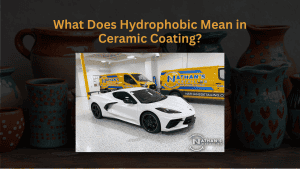
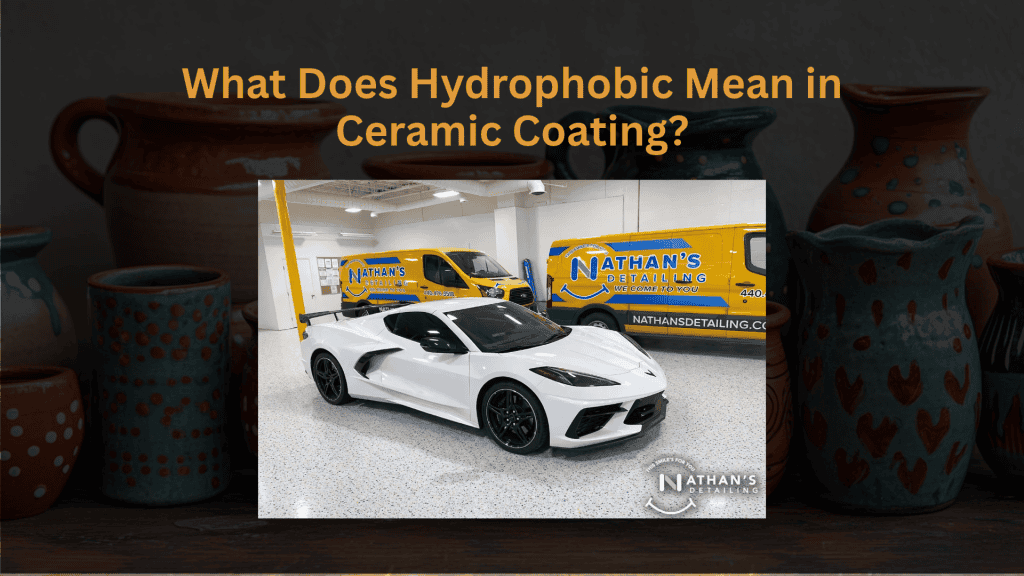

Hydrophobic in ceramic coating means the coated surface resists water wetting, causing water to form rounded droplets instead of spreading into a thin film. Ceramic coatings change how water interacts with automotive paint. Depending on the coating’s surface chemistry, droplet adhesion, panel angle, and contamination, water may bead, move, or drain away. Hydrophobic behavior can make a vehicle easier to rinse and maintain, but it does not make the surface waterproof, scratch-proof, self-cleaning, or immune to water spots.
What does hydrophobic mean in ceramic coating?
Hydrophobic describes a surface that resists being wetted by water. On ceramic-coated automotive paint, this resistance commonly appears as rounded water droplets rather than a continuous layer of water.
In surface science, wettability describes how a liquid behaves when it contacts a solid. Hydrophobic surfaces have lower wettability with water than hydrophilic surfaces.
The ceramic coating creates a new outer interface above the existing automotive finish. Water contacts that treated surface rather than interacting directly with untreated clear coat.
A coating’s hydrophobic behavior is separate from its physical durability, chemical resistance, and expected service life. Nathan’s explains these distinctions in our guide to how ceramic coating works on automotive paint.
How does hydrophobic ceramic coating make water bead?
Hydrophobic ceramic coating changes the surface chemistry and interfacial behavior that control how water wets automotive paint.
When a droplet contacts a coated panel, surface tension and the interfacial energies among water, air, and the coating influence its shape. A hydrophobic surface generally favors a smaller contact area and a more rounded droplet.
Microscopic surface texture can also influence wetting behavior. However, the behavior of a real coating depends on its complete chemistry, surface condition, and contamination.
Water contacts the surface
A droplet reaches the outermost ceramic coating or material currently covering it.
Wetting is resisted
Interfacial properties cause water to spread less readily across the treated surface.
Droplets form and move
Droplet adhesion, gravity, airflow, and panel inclination determine whether water remains or runs off.
Does hydrophobic coating physically push water away?
No. Hydrophobic coating does not create a force that actively pushes water off the paint. Its surface changes the balance of interfacial energies, making spreading less favorable.
A droplet may remain attached even when its shape is highly rounded. Movement requires sufficient force to overcome resistance at the contact line.
What is water contact angle in ceramic coating?
Water contact angle is the angle formed where a water droplet meets a solid surface, measured through the liquid. It is one of the main scientific measurements used to describe wettability.
A larger contact angle generally indicates that water spreads less readily. A smaller contact angle indicates greater wetting.
| Water Contact Angle | Surface Classification | Meaning |
|---|---|---|
| Less than 90° | Hydrophilic | Water wets the surface relatively readily. |
| Greater than 90° | Hydrophobic | Water resists spreading and forms more rounded droplets. |
| Greater than 150° | Superhydrophobic contact-angle range | Extremely high apparent water repellency; low adhesion is an additional consideration. |
The exact angle must be measured under defined conditions. Droplet size, temperature, contamination, and measurement technique can influence the result.
Does a 150-degree contact angle make ceramic coating better?
A 150-degree contact angle alone does not prove superior ceramic coating performance. It describes very high resistance to water wetting, but does not establish durability, chemical resistance, or scratch protection.
Researchers also evaluate how strongly water droplets adhere to a surface. A large contact angle and easy droplet release are not necessarily the same property.
What is contact-angle hysteresis in ceramic coating?
Contact-angle hysteresis is the difference between the advancing and receding contact angles of a liquid droplet on a surface. This difference helps describe resistance to movement of the droplet’s contact line.
The advancing contact angle describes the front edge of a growing or moving droplet. The receding contact angle describes the trailing edge as the liquid withdraws.
Greater hysteresis is often associated with stronger droplet pinning. Lower hysteresis can support easier water movement, although actual runoff also depends on droplet volume and other conditions.
Why can water beads remain stuck to ceramic-coated paint?
Water beads can remain attached because the surface resists movement of the droplet’s contact line.
This explains why a surface can show impressive round droplets but still retain water on the hood or roof.
The distinction matters during vehicle drying. An attractive water-beading pattern does not necessarily indicate that less water remains on the vehicle.
What is the difference between water beading and water sheeting?
Water beading describes the formation of discrete rounded droplets, while water sheeting describes the movement of connected water across a surface during rinsing.
Beading illustrates water’s tendency to resist spreading. Sheeting is commonly used in automotive detailing to describe how water drains away during a continuous rinse.
| Property | Water Beading | Water Sheeting |
|---|---|---|
| Primary observation | Droplet formation and shape | Water flow and drainage |
| Common situation | Light rain or spray | Continuous rinse |
| Scientific interpretation | Surface wetting behavior | Flow affected by adhesion, water delivery, and panel geometry |
| Maintenance implication | Droplets may remain on flat panels | Runoff may leave less retained rinse water |
Is water sheeting better than water beading?
Neither water sheeting nor water beading is universally better. For practical drying, efficient runoff and reduced standing water may matter more than highly rounded droplets.
A hydrophobic coating may demonstrate both behaviors depending on the amount of water applied and the angle of the vehicle panel.
Does hydrophobic ceramic coating prevent water spots?
Hydrophobic ceramic coating does not completely prevent water spots because water droplets can leave dissolved minerals behind when they evaporate.
Water may contain calcium, magnesium, and other dissolved substances. When a droplet evaporates, these substances can remain on the paint as visible deposits.
Water spotting can occur even on strongly hydrophobic surfaces because reduced wetting does not eliminate evaporation or mineral content.
How can you reduce water spots on a ceramic-coated car?
- Wash the vehicle outside intense direct sunlight when practical.
- Rinse thoroughly to remove detergent and suspended contamination.
- Use clean, soft microfiber drying towels or a suitable air blower.
- Remove standing water before it evaporates.
- Address fresh mineral deposits promptly with approved products.
- Avoid aggressive polishing or abrasive spot removal.
XPEL sells a dedicated water-spot remover formulated for compatible automotive paint, film, and ceramic-coated surfaces. Product compatibility and application instructions should still be checked for the installed coating.
What are the practical benefits of hydrophobic ceramic coating?
Hydrophobic ceramic coating can reduce water wetting, support easier rinsing, and make some contamination easier to remove from treated automotive paint.
These benefits arise from the coating’s surface properties and depend on maintenance, contamination, and the specific product formulation.
- Water repellency: Water forms more defined droplets on treated surfaces.
- Rinsing: Water and loosely held contamination may move more readily.
- Cleaning: Some dirt may be easier to remove during washing.
- Drying: Efficient runoff can reduce remaining rinse water.
- Appearance: A properly maintained surface can retain a clean, glossy appearance.
Does hydrophobic ceramic coating make a car self-cleaning?
No. Hydrophobic ceramic coating does not remove the need to wash a car.
Water movement may help release some loose particles, but oily road film, bug residue, bonded contaminants, bird droppings, and mineral deposits can still accumulate.
A coating marketed as self-cleaning should not be interpreted as maintenance-free.
Why does ceramic coating stop beading water?
Ceramic coating can stop visibly beading water because contamination or product residue changes the exposed surface, or because the coating’s functional properties have deteriorated.
Water interacts with whatever material is currently at the outermost surface. A layer of road film or mineral residue can therefore change observed wetting behavior without necessarily indicating that the entire coating has disappeared.
| Possible Cause | What Happens | Next Step |
|---|---|---|
| Road film | Dirt masks the original coating surface. | Use compatible washing. |
| Mineral deposits | Residues interfere with water behavior. | Evaluate safe deposit removal. |
| Maintenance product residue | A separate material changes the exposed surface. | Review product compatibility. |
| Coating deterioration | Original surface properties may be reduced. | Professional inspection may be needed. |
Can washing restore ceramic coating hydrophobicity?
Washing may restore visible hydrophobic behavior when contamination has been masking the coating. Cleaning cannot rebuild material that has already worn away.
If compatible washing does not improve water behavior, the surface may need appropriate decontamination or professional inspection.
Does ceramic coating booster restore the original ceramic layer?
A ceramic booster can improve water repellency by adding or modifying the exposed surface, but that does not prove the original coating has been restored.
XPEL describes Ceramic Boost as a maintenance product that adds a smooth, glossy, hydrophobic layer. Its performance should not be confused with a new full professional coating installation.
How can you check whether ceramic coating is still hydrophobic?
Check ceramic coating hydrophobicity by observing droplet formation and runoff after carefully washing and rinsing the surface under consistent conditions.
A visual test can help identify changes over time, but it cannot accurately measure contact angle without suitable equipment.
Clean the panel
Remove loose dirt using a compatible wash method.
Rinse consistently
Use similar water flow and conditions each time.
Observe and compare
Examine water beading, runoff, and retained water.
How should you maintain hydrophobic ceramic coating?
Maintain hydrophobic ceramic coating through regular washing, complete drying, prompt contaminant removal, and product-compatible aftercare.
XPEL’s official FUSION PLUS maintenance guidance recommends routine cleaning, compatible products, careful drying, and avoiding aggressive polishing of the coating.
- Follow the specific coating’s initial curing restrictions.
- Wash regularly to prevent contamination buildup.
- Avoid harsh or unapproved cleaning chemicals.
- Dry the vehicle after rinsing.
- Remove bug residue, bird droppings, and water spots promptly.
- Use compatible maintenance products where appropriate.
- Follow any inspection requirements attached to the warranty.
Should you use automatic car washes on ceramic coating?
Brush-style automatic washes are generally a poor choice for preserving a coated finish because contaminated brushes and aggressive contact can cause surface marring.
XPEL recommends suitable gentle washing procedures for its coatings. Follow the installed product’s aftercare guidance rather than assuming that every automatic wash is safe.
Does hydrophobic ceramic coating protect against Ohio winter road salt?
Hydrophobic ceramic coating may help winter grime release more easily from treated paint, but it cannot prevent every effect of road salt exposure.
Cleveland-area vehicles encounter winter salt, slush, road film, and repeated moisture exposure. These conditions make routine cleaning important even when a vehicle has professionally installed paint protection.
The coating on exterior paint does not automatically protect untreated underbody metal, seams, or hidden components.

Can road salt permanently damage ceramic coating?
Salt contamination and related road grime can affect coated surfaces when allowed to remain, especially alongside abrasive dirt and repeated wet-dry cycles.
The actual degree of resistance depends on the formulation and exposure. Regular cleaning remains necessary to protect the appearance and function of the coating.
Is hydrophobic ceramic coating the same as paint protection film?
No. Hydrophobic ceramic coating primarily modifies surface wetting and maintenance properties, while paint protection film adds a physical polymer barrier for protection against certain impacts and abrasion.
Both products can exhibit water repellency. However, water beading does not establish impact resistance.
Drivers who want to reduce stone-chip damage to front-facing panels should explore paint protection film separately from ceramic coating.
What hydrophobic ceramic coating services does Nathan’s Detailing offer?
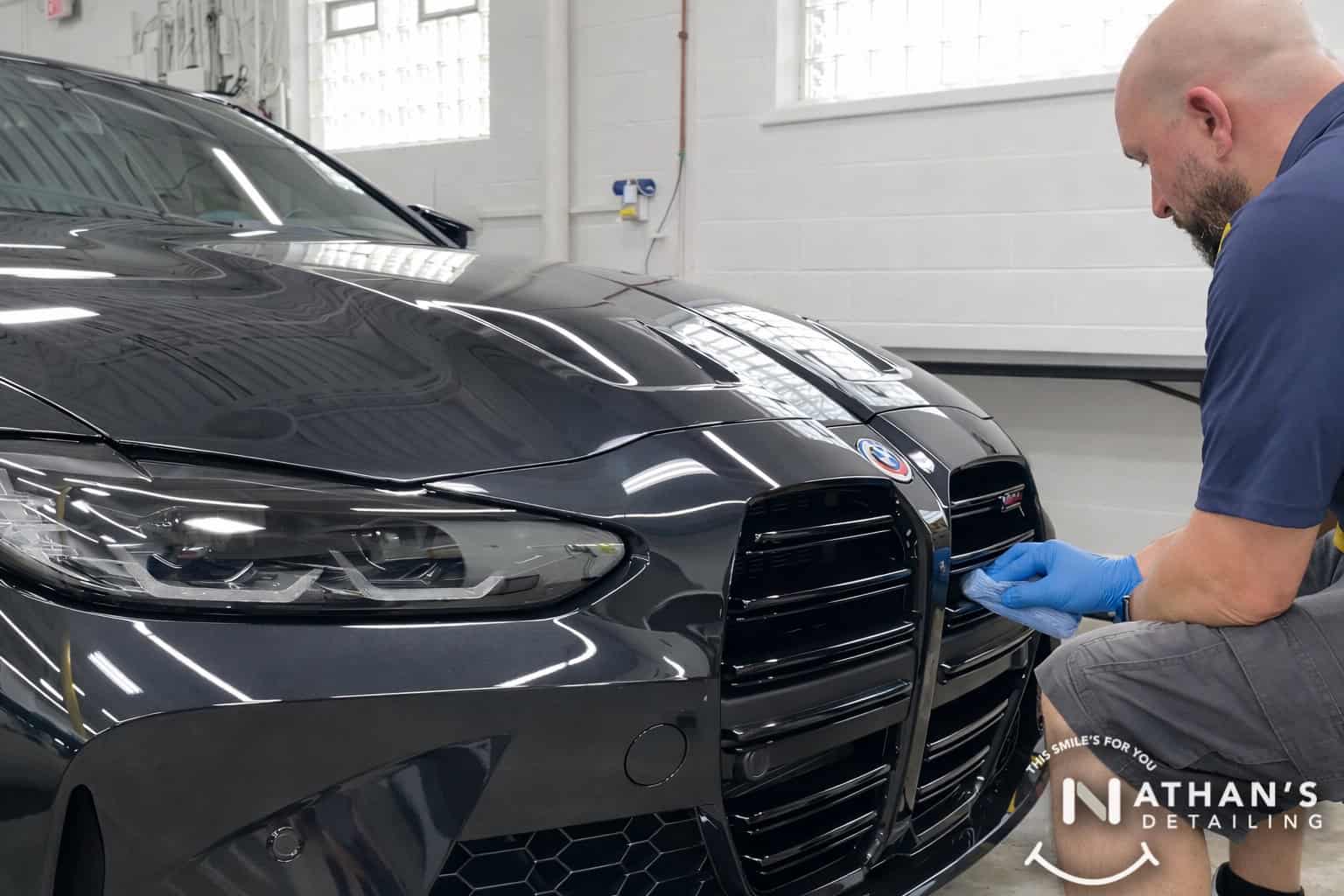
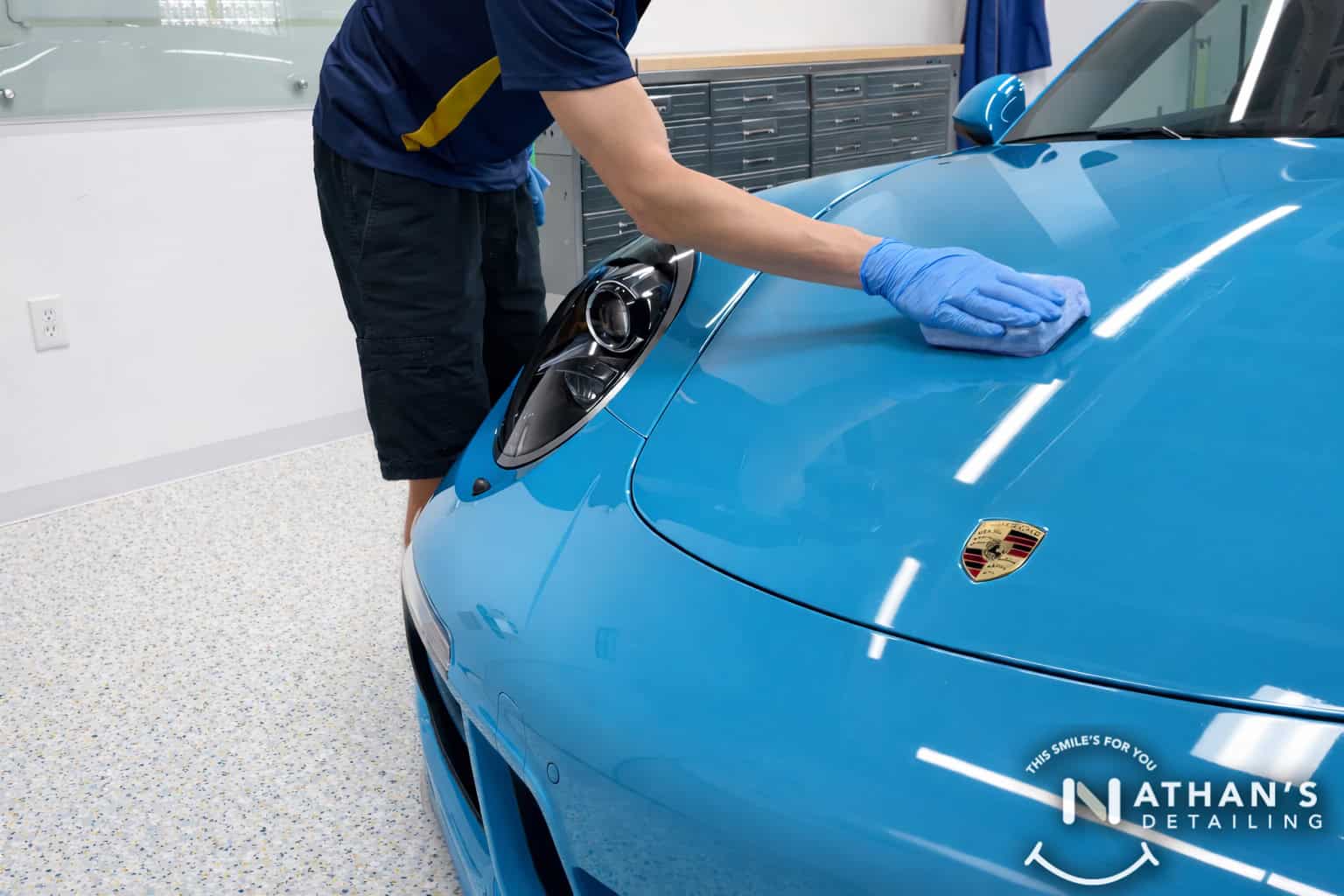
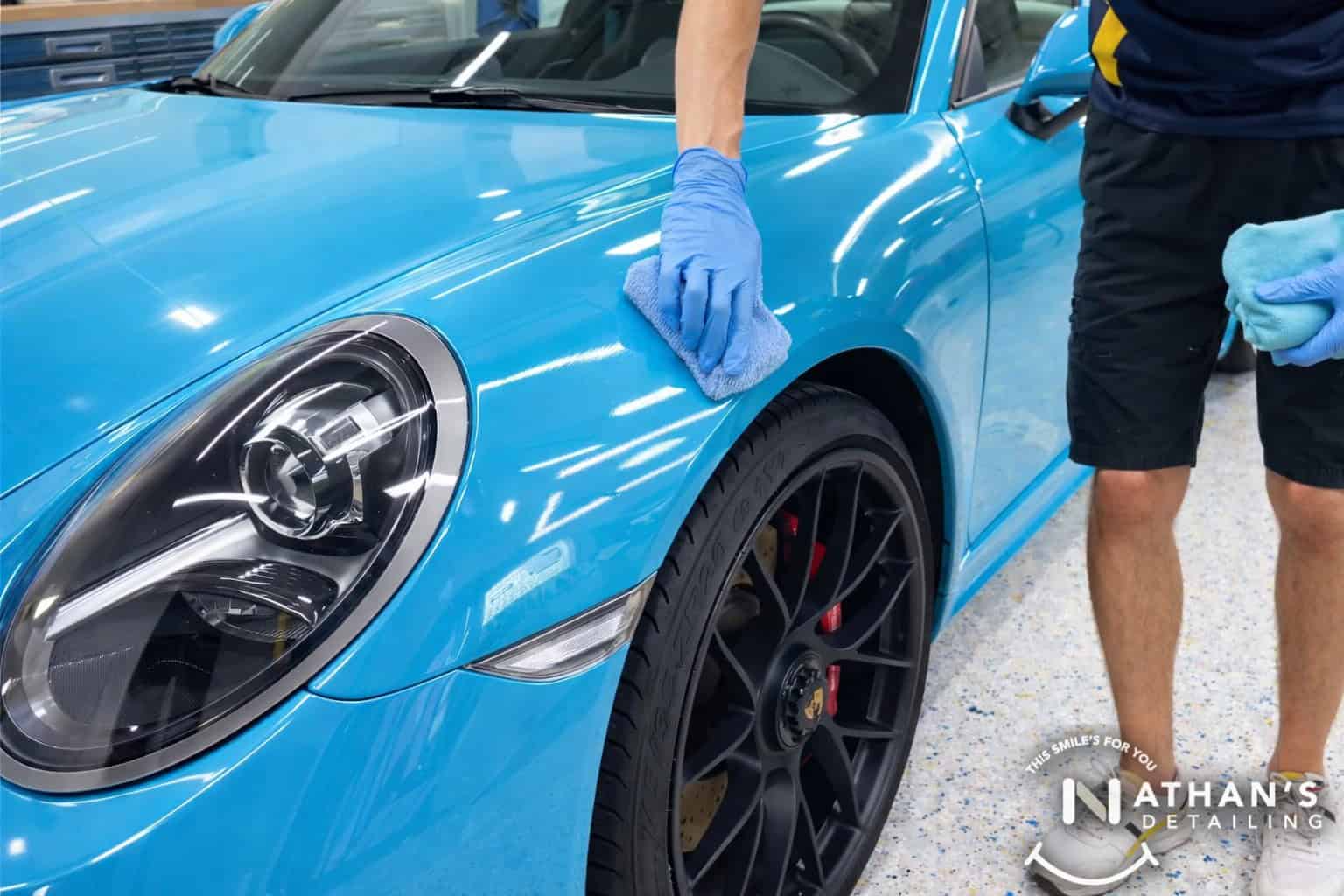
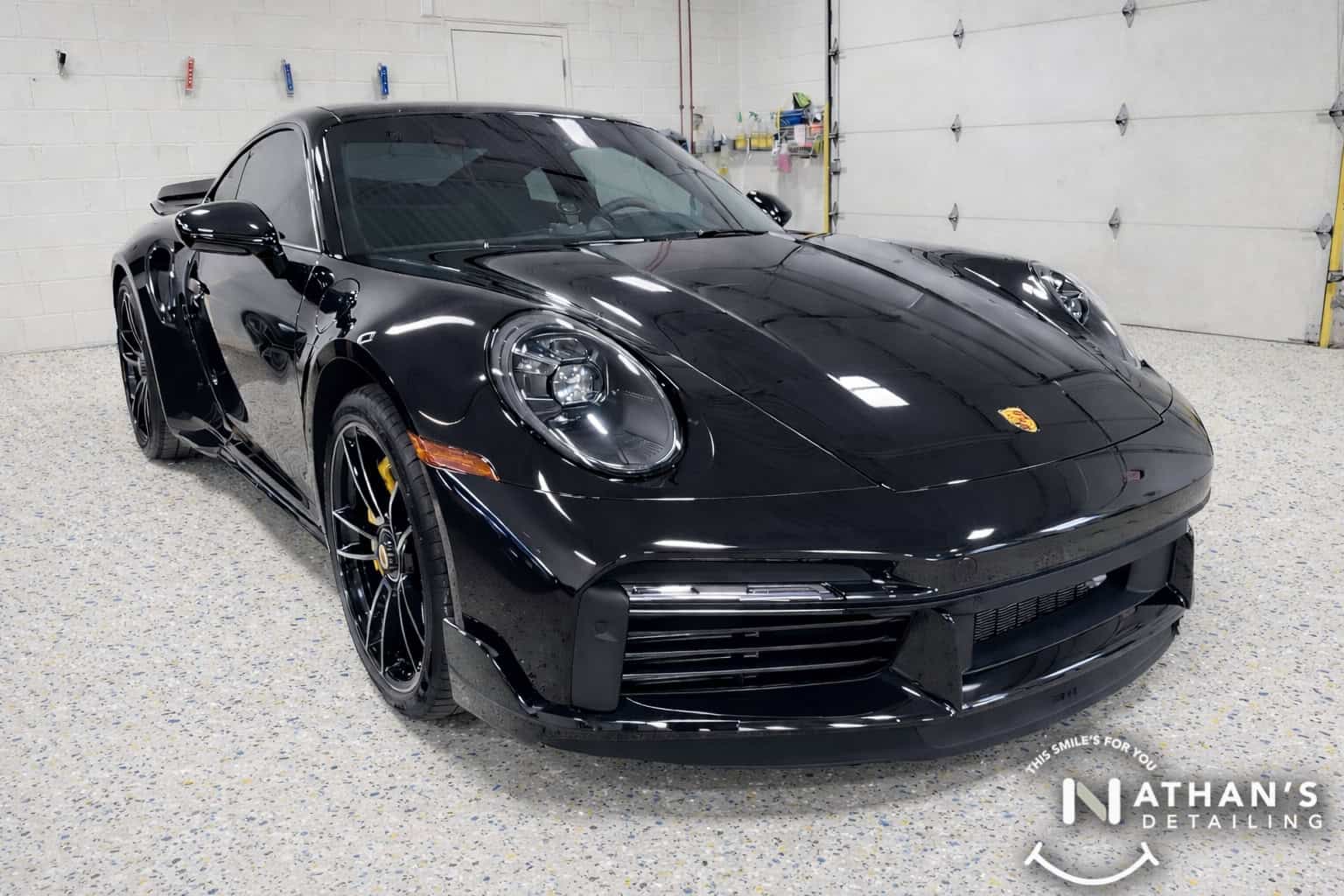
Nathan’s Detailing offers professional XPEL ceramic coating packages at our controlled installation studio serving Cleveland and surrounding Northeast Ohio communities.
Our published service options include XPEL Fusion, XPEL Fusion Plus, and XPEL Fusion Plus Premium.
| Package | Coating System | Advertised Warranty |
|---|---|---|
| 2-Year Ceramic Coating | XPEL Fusion | 2 years |
| 5-Year Ceramic Coating | XPEL Fusion Plus | 5 years |
| 8-Year Ceramic Coating | XPEL Fusion Plus Premium | 8 years |
These warranty periods describe Nathan’s published package terms. They are not measurements of contact angle or guarantees that water repellency will remain identical throughout the warranty.
Our service process includes surface assessment, preparation, application, curing, and final inspection according to the selected package.
We also maintain local service information for ceramic coating customers in Beachwood and Hudson.
Explore Ceramic Coating at Nathan’s Detailing
Our team can help you select a ceramic coating package based on your paint condition, vehicle use, ownership plans, and maintenance expectations.
View Ceramic Coating PackagesFrequently asked questions about hydrophobic ceramic coating
Does hydrophobic mean waterproof?
No. Hydrophobic means resistance to water wetting. Water can still remain on coated paint, especially on horizontal panels.
Does water beading prove that ceramic coating is still intact?
No. Beading demonstrates surface water repellency, but cannot independently establish coating condition, remaining durability, or chemical resistance.
What contact angle is considered hydrophobic?
A water contact angle greater than 90 degrees is conventionally classified as hydrophobic. Contact angles greater than 150 degrees fall into the superhydrophobic range, although droplet mobility is an additional consideration.
Why does rainwater remain on ceramic-coated paint?
Droplet adhesion, contact-angle hysteresis, panel angle, and droplet size can prevent rounded water beads from moving away.
Can ceramic coating lose water repellency?
Yes. Contamination, surface residue, and degradation can reduce visible hydrophobic behavior. Appropriate cleaning may help when contamination is the cause.
Does ceramic coating eliminate winter washing?
No. Salt, road grime, and other contaminants must still be removed regularly to maintain the vehicle’s exterior.
Can ceramic coating prevent scratches?
No. Hydrophobicity is a water-wetting property. Ceramic coating does not make automotive paint scratch-proof or replace paint protection film.
Can a coating booster improve water beading?
Yes. Compatible boosters can create or enhance surface water repellency, but stronger beading after application does not prove that the original coating has been restored.
What should you remember about hydrophobic ceramic coating?
- Hydrophobic means resistance to water wetting.
- Contact angles above 90 degrees generally indicate hydrophobic behavior.
- Contact angles above 150 degrees indicate the superhydrophobic range.
- Contact-angle hysteresis helps explain why droplets may stick.
- Water beading and water sheeting are different observations.
- Water repellency does not prevent every mineral water spot.
- Strong water beading does not guarantee coating durability.
- Contamination can mask hydrophobic behavior.
- Regular washing and drying remain necessary.
- Professional coating selection should account for formulation and maintenance.
Scientific and technical references
[1] Royal Society of Chemistry — Superhydrophobic Materials and Wetting Models. Explains contact angles, wetting states, and the scientific foundations of superhydrophobic surfaces.
[2] NIST — Tribology of Non-Adhesive Surfaces. Examines wetting, contact-angle hysteresis, and surface-structure effects on adhesion.
[3] XPEL — Official FUSION PLUS Product Care. Provides maintenance instructions covering washing, drying, contamination removal, and warranty inspection.
[4] Nathan’s Detailing — What Is Ceramic Coating? Explains protective coating function, water repellency, and limitations in automotive applications.
[5] Nathan’s Detailing — Ceramic Coating Services. Describes current XPEL service packages, application processes, and warranty options.
Scientific research: Royal Society of Chemistry — Wetting Models | Manufacturer instructions: XPEL Product Care.
Manufacturer product claims and service warranty conditions should not be generalized to every ceramic coating formulation.