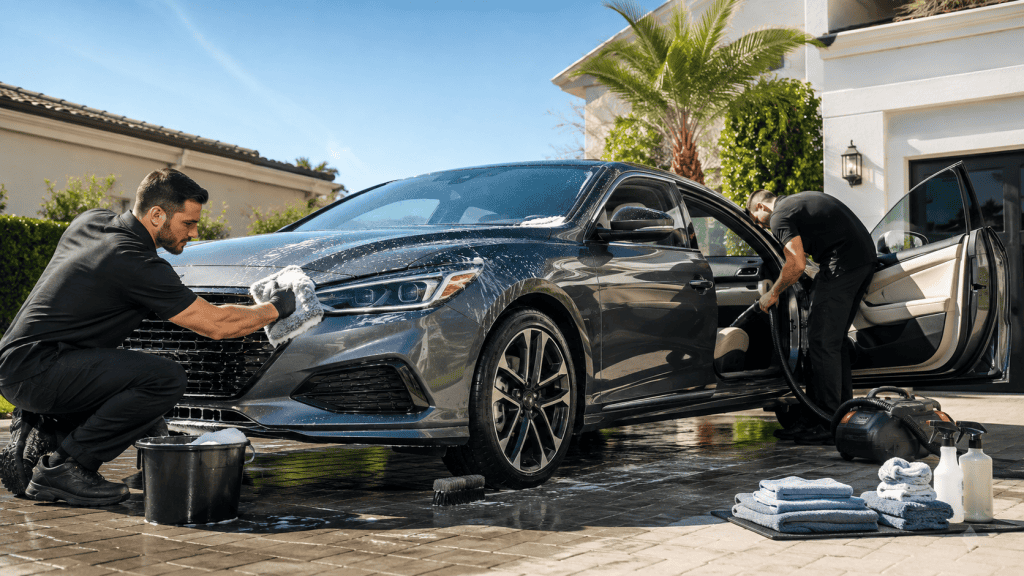

Mobile car detailing can include package-defined interior cleaning, exterior washing, decontamination, polishing or protection at an approved customer location. Exact inclusions depend on the provider, selected package, vehicle condition and operating environment.
“Mobile” describes how the service is delivered. “Detailing” describes the professional appearance-care tasks performed on the vehicle. A mobile detailer establishes a temporary workspace at the customer’s home, workplace or another permitted location instead of requiring the vehicle to remain at a fixed shop.
No universal mobile detailing package exists. The International Detailing Association describes detailing as thorough interior and exterior cleaning and reconditioning, but individual businesses still determine which areas, methods and products belong in each package.
The written service description therefore controls the included work. A package may cover the interior, exterior or both without automatically including carpet extraction, clay decontamination, machine polishing, paint correction or ceramic coating.
This guide explains which interior and exterior tasks mobile detailing can include, which treatments are package dependent, what normally costs extra and how to compare service descriptions before booking.
What Does Mobile Car Detailing Usually Include?#
Mobile car detailing usually includes an assessment, package confirmation, package-defined cleaning, quality control and customer handoff. These appointment stages establish what will be treated, which methods are suitable and how the completed work will be checked.
Mobile detailing begins with a vehicle-condition assessment#
Mobile detailing begins with a vehicle-condition assessment that identifies visible contamination, sensitive materials and service limitations.
The assessment connects the vehicle’s actual condition with the booked package. A detailer may document existing scratches, torn upholstery, failed paint, heavy contamination, prior coatings, paint protection film, sensitive electronic surfaces and the customer’s primary concerns before selecting products or equipment.
Weather, work location, vehicle construction, available equipment and chemical compatibility can all change how a detailing procedure is carried out. A surface assessment is especially important before processes such as abrasive polishing, clay decontamination or film preparation.
This inspection creates a working baseline for appearance care. It is not a mechanical, collision, structural or body-repair inspection, and it cannot identify every hidden defect beneath the vehicle’s surfaces.
The detailer confirms the booked package and service boundaries#
The mobile detailer confirms the booked package so included tasks, exclusions and condition-dependent work are understood before treatment begins.
Package confirmation separates four different categories: baseline inclusions, condition charges, optional add-ons and work requiring another service environment. It should also address realistic result limitations, such as permanent staining, physical damage or scratches that cannot be safely removed.
At Nathan’s Detailing, for example, our Premium Interior, Premium Complete and Platinum Complete packages contain different treatment depths. The Premium Complete package adds exterior maintenance work, while the Platinum package adds clay decontamination, machine polishing and ceramic protection. This is our current package structure rather than a universal industry model.
Confirming the package converts a promotional name into an operational task list. The technician and customer should understand which surfaces will be treated before equipment or cleaning products are used.
Interior or exterior cleaning is completed according to the package#
Mobile detailing completes interior, exterior or combined cleaning according to the selected package.
An interior-only package concentrates on cabin surfaces. An exterior package addresses paint, glass, wheels, trim or protection. A complete package combines selected tasks from both categories, while maintenance and condition-based services may provide a different treatment depth.
Service area and service depth are separate attributes. A package may cover the entire interior and exterior without including the deepest available treatment for every surface.
“Complete detail” is therefore a provider-defined package name, not a standardized technical term meaning every possible detailing process is included.
Products and tools are selected for the material and contamination#
Mobile detailing products and tools are selected according to the material, contamination type and existing surface condition.
Carpet, textile seating, coated synthetic seats, natural leather, screens, plastics and gloss trim may require different products even when they are next to one another. Exterior paint, matte finishes, glass, wheels, wraps, paint protection film and ceramic coatings also have different chemical and mechanical limitations.
Tesla, for example, gives separate instructions for textile and synthetic seating and warns that unsuitable chemicals or tools can cause deterioration or discoloration. Ford similarly restricts carpet, leather, vinyl and glass products to specific materials.
A bottle labelled “interior cleaner” does not prove compatibility with every material inside a vehicle. Material identification must come before product selection.
The appointment ends with quality control and customer handoff#
A mobile detailing appointment ends with a quality-control inspection, correction of missed booked tasks and customer handoff.
The technician checks for remaining debris, product residue, streaked glass, uneven dressing, incomplete areas and other correctable issues within the agreed package. Product-specific aftercare should also be explained when wax, sealant, fabric protection or another protective treatment has been applied.
Inspection lighting matters when evaluating paint. In its professional paint-finishing guidance, 3M separates scratch refinement, compounding, polishing and inspection and recommends lighting that resembles daylight when checking for remaining marks.
Quality control verifies that the booked tasks were completed. It does not mean permanent staining, physical damage or every paint defect has disappeared.
| Appointment Stage | Included Function | Purpose |
|---|---|---|
| Assessment | Visible condition and scope review | Match the service to the vehicle |
| Package confirmation | Inclusion, exclusion and charge review | Define the agreed work |
| Setup | Equipment and work-area preparation | Establish the temporary workspace |
| Treatment | Interior, exterior or combined tasks | Complete the booked processes |
| Quality control | Final inspection and touch-ups | Verify task completion |
| Handoff | Result review and aftercare | Explain the completed work |
What Is Included in Exterior Mobile Car Detailing?#
Exterior mobile car detailing can include washing, wheel cleaning, targeted contaminant treatment, decontamination, polishing and protection when listed in the package. These processes form an exterior-treatment ladder, but selecting one level does not automatically include the levels above it.
Exterior washing removes loose dirt and washable road contamination#
Exterior washing removes loose dirt and other contamination that an appropriate wash process can release from the vehicle.
The process may include a pre-rinse, cleaning-solution application, controlled contact washing, low-water washing, rinsing when required and drying. The selected method depends on the amount of contamination, product instructions, operating location and any protection already present on the vehicle.
Outdoor vehicle washing also requires wastewater awareness. The U.S. Environmental Protection Agency states that detergent-rich wash water can contain nutrients, metals and hydrocarbons and may enter local waterways through storm drains. Applicable local runoff requirements should therefore be checked rather than assuming every driveway is suitable.
A hand wash describes the contact method. It does not automatically establish that bonded contamination, scratches or paint defects will be removed.
Wheel and tire cleaning addresses exposed road contamination#
wheel and tire cleaning treats exposed brake dust, road film and soil on the surfaces included in the package.
Customers should confirm whether the service covers only the wheel faces or also the accessible barrels, tires and wheel wells. Wheel design, clearance, finish condition and accumulated contamination can limit access and alter the compatible cleaning method.
Cleaning products must match the surface. A chemical suitable for a tire may be unsuitable for polished, painted, anodized or otherwise sensitive wheel finishes. Manufacturer restrictions on material-specific cleaners demonstrate why one product should not be assumed safe for every surface.
Wheel cleaning and wheel protection are separate treatment stages. Baked-on contamination, corrosion, curb damage and failed finishes may remain after appropriate cleaning.
Bug, tar and road-film treatment may be included#
Bug, tar and road-film treatment is included only when the package names targeted exterior-contamination removal.
The selected treatment depends on the contaminant, how long it has remained on the surface, the affected material and any previous staining or etching. An appropriate product may dissolve or release residue without reversing physical or chemical damage already created beneath it.
A mark that remains before washing cannot always be classified accurately. Removing loose surface material first helps distinguish removable residue from staining, etching, paint transfer or clear-coat damage.
Targeted treatment therefore differs from ordinary washing, and complete removal should not be promised before the surface has been inspected.
Door jambs, exterior glass and trim may be cleaned#
Door jambs, exterior glass, mirrors and accessible trim are included only when the package identifies those areas.
Cleaning these surfaces is different from dressing, polishing, restoring or replacing them. Exterior trim restoration, exhaust-tip polishing, mineral-spot correction and glass polishing should not be assumed from a general statement that the exterior will be cleaned.
Window film, plastic trim, gloss-black panels, textured plastics and decorative finishes may require different chemicals and tools. Manufacturer-specific restrictions demonstrate that products must be matched to the actual surface.
Cleaning a trim component does not automatically mean a protectant or dressing will be applied to it.
Exterior decontamination is included only when stated#
exterior paint decontamination is included only when the package identifies chemical or mechanical treatment for bonded contamination.
Bonded contamination is material that remains attached after ordinary washing. Depending on the condition, treatment may involve an iron or fallout remover, clay treatment, contaminant-specific chemical or another compatible method.
Decontamination normally follows washing because loose soil must be removed before the technician can accurately feel or evaluate attached material. It also precedes paint polishing when a clean surface is required for defect assessment.
Removing material from the paint and refining the paint itself are different processes. Clay decontamination does not automatically remove swirl marks, scratches, oxidation or haze.
Machine polishing is included only in packages that name it#
Machine polishing is included only when the package names an abrasive paint-finishing process.
Terms such as gloss enhancement, finishing polish, one-step correction, spot correction and multi-stage correction describe different possible objectives and levels of defect removal. The technician must assess the paint, clear-coat condition and defect depth before selecting the process.
3M separates defect removal, scratch refinement, compounding, polishing and final inspection into distinct stages. This separation demonstrates why “machine polish” does not reveal how much paint refinement a customer is purchasing.
The presence of a polishing machine does not establish the number of stages or the percentage of defect removal. Some scratches extend too deeply to be safely removed through polishing.
Wax, sealant or ceramic protection must be identified separately#
Wax, sealant, spray ceramic and professional ceramic coating must be identified separately because they use different products and preparation requirements.
A useful service description should identify the product category, treated surfaces, required preparation, application method, advertised durability and maintenance expectations. The word “ceramic” by itself does not establish that a multi-year professional ceramic coating is being installed.
Product-specific cure and durability values cannot be universalized. One XPEL FUSION PLUS technical data sheet, for example, lists six hours before exposure to water and a three-day cure time for the identified coating. Those values apply to that product rather than every ceramic-labelled treatment.
At Nathan’s Detailing, our Platinum mobile package currently includes ceramic wax advertised for up to nine months. Our separate multi-year XPEL ceramic coatings are installed in our controlled studio.
Protection terminology becomes meaningful only when it is connected to an identified product and application process.
Exterior detailing ends with a final surface inspection#
Exterior detailing ends with a final inspection for residue, streaks, remaining contamination and incomplete included work.
The inspection may cover paint residue, glass clarity, dressing consistency, trim condition, missed wheel areas and any included protective application. Lighting angle and intensity influence whether paint haze, residue or remaining defects are visible.
3M recommends inspection between paint-finishing stages and lighting that approximates natural daylight because compounds and polish residue can conceal remaining marks.
Inspection does not alter the surface. It improves the technician’s ability to verify that the booked treatment was completed correctly.
| Exterior Task | Inclusion Status | Function | Main Boundary |
|---|---|---|---|
| Exterior washing | Common in exterior packages | Removes washable contamination | Does not automatically remove bonded contamination |
| Wheel and tire cleaning | Common but scope dependent | Cleans specified exposed surfaces | Coating or polishing may be separate |
| Bug and tar treatment | Package dependent | Targets named contamination | Etching or damage may remain |
| Door-jamb and trim cleaning | Package dependent | Cleans specified secondary areas | Restoration is separate |
| Decontamination | Package dependent | Removes bonded contamination | Does not correct paint defects |
| Machine polishing | Package dependent | Refines eligible defects | Not every defect is safely removable |
| Wax or sealant | Package dependent | Adds temporary protection | Durability depends on the product and conditions |
| Professional ceramic coating | Separate advanced service | Applies a prepared coating system | Requires product-specific preparation and curing |
What Is Included in Interior Mobile Car Detailing?#
Interior mobile car detailing can include vacuuming, crevice cleaning, material-specific surface treatment, stain treatment, glass cleaning and final inspection. The package should distinguish loose-debris removal from deeper textile treatment and optional protection.
Interior vacuuming removes loose debris from accessible areas#
Interior vacuuming removes loose debris from the seats, carpet, mats and other accessible areas named in the package.
The trunk, cargo area, third row, under-seat spaces and storage compartments should be confirmed rather than assumed. An area may be physically reachable while still remaining outside the written service description.
Vacuuming relies on airflow and suction. It does not chemically treat stains or automatically remove fibre-embedded pet hair, dried liquid contamination or material discoloration. Tesla’s material-care guidance, for example, distinguishes routine vacuuming from treatment of spills and stains.
Equipment capability also varies. One current Mytee automotive extractor is rated at 100 cubic feet per minute of airflow and 130 inches of water lift, but these are specifications for that machine rather than an industry minimum.
Cracks, crevices and vents receive targeted cleaning#
Cracks, crevices and vents receive targeted cleaning when the package includes detailed work beyond open-surface vacuuming.
These areas may include console seams, cup holders, seat rails, door pockets, trim joints and other accessible gaps. Depending on the material and contamination, treatment may involve vacuuming, brushing, controlled compressed air, steam or manual wiping.
Each method performs a different function. Brushing loosens attached debris, airflow moves particles from narrow spaces and wiping removes contamination from reachable surfaces.
“Detailed” should therefore identify an area or process rather than function as a vague quality claim. Removal of seats, trim panels or other components should not be assumed unless disassembly is specifically included.
Dashboard, console and door surfaces are cleaned according to material#
Dashboard, console and door surfaces are cleaned according to their material, finish and electronic sensitivity.
A modern dashboard may combine textured plastics, vinyl, coated trim, gloss-black surfaces, touchscreens, switches, cameras and open seams. Products and moisture levels suitable for one component may be unsuitable for the adjacent surface.
Tesla instructs owners to use a soft display-compatible cloth on touchscreens and warns against ordinary glass cleaners, alcohol gels, wet wipes and statically charged materials. Its Screen Clean Mode prevents accidental control activation during cleaning.
A screen and the dashboard surrounding it may require different methods despite belonging to the same assembly. Dressing or UV protectant should be treated as a separate inclusion rather than assumed.
Seats are treated according to upholstery type#
Vehicle seats are treated according to whether the upholstery is textile, vinyl, coated synthetic material, natural leather or a mixed construction.
Possible seat treatments include vacuuming, surface cleaning, spot treatment, compatible agitation and protection when named in the package. The selected process must account for top coatings, stitching, perforation, occupancy sensors and any manufacturer restrictions.
Tesla publishes different instructions for synthetic and textile seating, while Ford’s product information separates carpet and upholstery cleaner from products intended for leather and vinyl.
Visual appearance alone does not reliably identify a seat’s material. A leather-like surface may be synthetic, coated or part of a mixed-material construction, so material identification should precede chemical selection.
Carpet and upholstery stain treatment is condition dependent#
carpet and upholstery stain treatment depends on the contaminant, textile, previous treatment and degree of permanent material change.
Food, drinks, mud, salt residue, dye transfer, oils and unknown marks respond differently to cleaning. The treatment may require spotting, controlled agitation, extraction or repeated passes, but each method must remain compatible with the underlying material.
Cleaning can remove contamination without reversing fading, abrasion, fibre damage or dye loss. Tesla notes that certain transferred dyes and oils cannot always be safely removed from its seating surfaces.
A visible mark is therefore not automatically a removable stain. Complete removal should not be promised until the material and cause have been assessed.
Steam or extraction is used only when suitable and included#
Steam and extraction are used only when the package includes them and the surface supports the selected process.
Extraction applies cleaning solution to compatible textiles and recovers liquid and suspended contamination through suction. One Mytee automotive extractor uses separate 15.1-litre solution and recovery tanks, a 120-PSI pump, 100-CFM airflow and a 1,000-watt heater. These figures describe that machine rather than universal detailing requirements.
Steam treatment uses heated vapor or moisture through equipment designed for that purpose. One Kärcher professional steam vacuum operates at up to eight bar and provides adjustable steam and vacuum modes, again demonstrating a product-specific capability rather than an industry minimum.
Steam and extraction change the appointment’s moisture, heat, drying, utility and equipment requirements. Neither process automatically proves that a surface has been sanitized or disinfected.
The EPA states that disinfectant effectiveness depends on an EPA-registered product being used according to its label directions. The target organism, surface, application method and required contact time all matter.
The functional differences between a vacuum, carpet extractor and steam cleaner explain why these tools are not interchangeable.
Pet-hair removal may require additional labor#
pet-hair removal may require additional labor when hair is embedded in carpet, upholstery or cargo-area materials.
Difficulty changes according to fibre construction, hair type, affected surface area, static attraction and how deeply the hair has become trapped. Loose hair may respond to routine vacuuming, while embedded hair can require repeated agitation and targeted tools.
At Nathan’s Detailing, our current mobile packages list a $59 extra-dirty or pet-hair charge for the additional time and tools required. This is our current condition charge rather than a universal pricing rule.
Pet-hair pricing reflects the condition and workload, not merely whether an animal has been inside the vehicle. Complete removal of every hair should not be guaranteed.
Interior glass is cleaned as a separate finishing task#
Interior glass cleaning is a separate finishing task covering the windows and mirrors listed in the package.
The service may cover the windshield, side windows, rear glass and mirrors. Tint film, display surfaces, reflective coatings and rear-window heating elements require compatible products and tools.
Tesla warns against scraping or using abrasive cleaning fluids on glass and mirrored surfaces because they can damage reflective surfaces and rear-window heating elements.
A transparent surface may contain films, coatings or electrical components that change the cleaning method. Scratches, failed tint and broken heating elements cannot be cleaned away.
Interior detailing ends with inspection and finishing#
Interior detailing ends with an inspection for debris, residue, streaks, dampness and incomplete package tasks.
The technician should check open surfaces, crevices, glass, treated seats and textiles, as well as the evenness of any included dressing or protection. Customer belongings should be accounted for according to the provider’s handling policy.
Textiles may remain damp after extraction or another moisture-based process. Dampness should be disclosed during the customer handoff rather than concealed with fragrance or an unsupported dryness claim.
A clean appearance and a fully dry textile are different result attributes. Immediate dryness should not be guaranteed after every extraction process.
| Interior Condition | Likely Process | Evidence Boundary |
|---|---|---|
| Loose crumbs and dust | Vacuuming and wiping | Does not treat embedded contamination |
| Dirty dashboard or console | Material-specific cleaning | Dressing may be separate |
| Textile staining | Spot treatment or extraction when compatible | Complete removal is not guaranteed |
| Embedded pet hair | Agitation and targeted removal | Additional labor may be charged |
| Coated or synthetic seating | Manufacturer-compatible cleaning | Do not assume natural leather |
| Interior-glass residue | Glass cleaning | Scratches and failed tint remain |
| Persistent odor | Source assessment and suitable cleaning | Hidden or mechanical sources may remain |
What Is Included in a Complete Mobile Car Detail?#
A complete mobile car detail combines selected interior and exterior tasks, but its exact inclusions remain provider defined. The package name should never replace a written list of the areas and processes being purchased.
A complete mobile detail combines selected interior and exterior tasks#
A complete mobile detail combines a stated interior process with a stated exterior process in one appointment.
Both service categories can share a condition assessment, workspace setup, package confirmation and final quality-control inspection. The technician then completes the specified cabin and exterior tasks with the tools and products required for each surface.
Combining the two categories does not automatically increase the depth of every treatment. An interior-and-exterior package may provide maintenance cleaning without extraction, clay decontamination or machine polishing.
A complete detail covers both areas at the level stated by the provider. It should not be interpreted as “everything the business offers.”
“Complete” does not mean every detailing process is included#
Complete does not mean that extraction, decontamination, polishing, coating or every optional treatment is included.
Our current Nathan’s Detailing packages demonstrate this distinction. Premium Complete includes our Premium Interior tasks plus a foam bath, hand wash, wheel and tire care, targeted road-contamination removal, door-jamb cleaning, exterior glass and wax. Platinum Complete adds clay decontamination, a high-gloss machine polish and ceramic protection.
Both packages use “Complete,” but their exterior treatment depth is different. This first-party example shows why the term cannot be treated as an industry standard.
The written process list—not the adjective attached to the package—determines what the service includes.
The order of work depends on the vehicle and package#
The order of a complete detail depends on the vehicle, contamination, weather, equipment and booked processes.
A technician may begin inside the cabin when textiles need drying time or start outside when washing is required before paint assessment. Weather, shade, runoff management, available space and equipment dependencies may also alter the sequence.
The International Detailing Association’s operating-procedure guidance recognizes that detailing procedures must be adapted to factors such as work location, vehicle, equipment, chemicals and weather.
A changing order of operations does not necessarily indicate an inconsistent service. The sequence should follow the dependencies of the booked processes.
Combined packages require more time and equipment than maintenance washing#
Combined detailing packages involve more surfaces, material categories and process stages than routine exterior washing.
Interior vacuuming, crevice work, material-specific cleaning, textile treatment, glass cleaning, exterior washing, wheel work and final inspection each add setup, product, equipment and quality-control requirements. Steam or extraction can also add utility and drying demands.
No universal duration applies because vehicle size, condition and package depth differ. At Nathan’s Detailing, we currently advise that most of our mobile appointments take approximately two to four hours, depending on vehicle size and condition. This is our operating estimate rather than an industry-wide duration.
The written task list defines the value of a complete detail#
The written task list defines the value of a complete detail because it identifies the surfaces, treatments and limitations being purchased.
A useful comparison should identify included areas, treatment methods, protection products, condition charges, expected results and aftercare. A longer task list is not automatically more valuable when those tasks do not address the vehicle’s actual condition.
For example, a vehicle with a clean cabin and contaminated paint may receive more value from a focused exterior service than from a broad maintenance package. A heavily soiled family vehicle may benefit more from a defined interior process than from additional exterior protection.
The most valuable complete detail is the package whose written tasks match the actual work required.
| Complete-Package Attribute | What to Verify | Why It Matters |
|---|---|---|
| Interior areas | Seats, carpet, mats, cargo area, crevices and glass | Confirms the treated cabin surfaces |
| Interior methods | Vacuuming, spot treatment, steam or extraction | Establishes treatment depth |
| Exterior areas | Paint, wheels, tires, jambs, trim and glass | Confirms exterior coverage |
| Exterior methods | Washing, decontamination and polishing | Separates cleaning from refinement |
| Protection | Wax, sealant, ceramic wax or coating | Identifies the applied product category |
| Condition charges | Pet hair, heavy soil, debris and stains | Clarifies possible price changes |
| Limitations | Permanent damage and inaccessible contamination | Sets realistic result expectations |
Which Services Are Usually Add-Ons to Mobile Detailing?#
Mobile-detailing add-ons are services that require additional labor, equipment, assessment or environmental control beyond the baseline package. The exact add-on list remains provider defined.
Heavy-condition cleaning may require additional labor#
Heavy-condition cleaning may require additional labor when contamination exceeds the package’s assumed starting condition.
Excess debris, heavy soil, repeated stain treatment, compacted material and contaminated cargo areas can increase the number of passes, product use and equipment time required to complete the agreed tasks.
At Nathan’s Detailing, our live package page currently lists a $59 extra-dirty charge for additional time and tools. The amount and qualifying condition belong to our current package structure rather than a national pricing standard.
A heavy-condition charge modifies the expected workload. It does not guarantee that permanent staining, material damage or every embedded contaminant will be removed.
Pet-hair removal is often condition priced#
Pet-hair removal can be condition priced because the affected material, surface area and depth change the required labor.
Loose hair on smooth seating may respond quickly to vacuuming, while hair trapped in carpet loops, seat fabric or cargo-area textiles may require repeated agitation and specialized tools.
Our current Nathan’s Detailing packages group extra-dirty condition and pet hair under a $59 additional charge. That first-party amount should not be treated as a standard used by other providers.
The price mechanism is condition based: the more deeply embedded and widely distributed the hair is, the more labor may be required.
Odor treatment requires source identification#
odor treatment requires source identification because the source can be on a surface, beneath a textile, inside ventilation components or mechanical.
Reachable contamination may respond to material-compatible cleaning. However, liquid beneath carpeting, contamination inside seat foam, mold in concealed areas, an HVAC problem or a mechanical leak can remain outside the scope of normal interior detailing.
An odor is a signal rather than a material classification. Masking the smell does not establish that the source has been removed.
The provider should inspect the accessible cabin, explain what can be treated and refer mechanical or inaccessible sources to the appropriate specialist. Odor elimination should not be guaranteed before the source is identified.
Engine-bay cleaning is normally a separate service#
Engine-bay cleaning is normally handled separately because electrical components, seals and existing leaks require additional assessment.
The service must distinguish surface cleaning from mechanical diagnosis. A technician may clean compatible accessible components without determining why fluid residue, corrosion or a leak is present.
Manufacturer instructions differ by vehicle. Ford, for example, publishes vehicle-specific engine-cleaning guidance, while also warning in other cleaning guidance that unsuitable high-pressure treatment can create water intrusion or seal damage.
Engine-bay cleaning should not be assumed within a complete detail, and it does not diagnose or repair mechanical conditions.
Headliner treatment may require separate assessment#
headliner cleaning may require separate assessment because construction, adhesive condition, moisture and prior sagging affect the safe method.
Light spot cleaning and broad wet treatment create different moisture demands. Aggressive agitation, saturation or extraction can be unsuitable for some headliner constructions, particularly when the material or adhesive has already deteriorated.
The technician should identify the material, inspect the condition and select the least intrusive compatible process. Vehicle-manufacturer material guidance supports adapting cleaning methods to the exact surface rather than relying on one universal method.
A visibly sagging or delaminated headliner may require upholstery repair instead of deeper cleaning.
Paint decontamination and polishing are separate exterior upgrades#
Paint decontamination and polishing are separate upgrades because one removes attached material and the other mechanically refines the finish.
Chemical or clay decontamination targets bonded particles remaining after washing. Polishing uses an abrasive combination of machine, pad and product to refine eligible clear-coat defects.
3M’s professional paint-finishing guidance treats defect removal, compounding and polishing as separate stages, supporting the distinction between cleaning contamination and altering the paint surface.
A vehicle may need bonded-contamination removal without requiring polishing. Another vehicle may have clean paint but still require an assessed polishing process.
Ceramic coatings and paint protection film are advanced protection services#
Professional ceramic coatings and paint protection film are advanced protection services requiring product-specific preparation, application and curing or adhesion conditions.
Surface preparation normally includes washing, contaminant removal, inspection and any required paint refinement. PPF installation adds product-specific slip solutions, positioning, edge work and adhesive management.
3M’s current installation bulletin specifies a recommended application range of 60°F to 85°F for the identified PPF products. XPEL technical data sheets provide product-specific drying and cure periods for its coatings. These figures demonstrate why environment and product instructions matter without creating universal installation requirements.
At Nathan’s Detailing, our multi-year ceramic coatings, PPF and window tint are performed in our Bedford protection studio rather than treated as ordinary mobile-detailing inclusions.
Child-seat cleaning or removal may require separate arrangements#
Child-seat cleaning, removal and reinstallation require separate arrangements because the restraint manufacturer controls approved cleaning and installation procedures.
The detailing provider should define whether it will move the seat, clean only the surrounding vehicle area, treat removable covers or reinstall the restraint. These are separate responsibilities.
NHTSA repeatedly emphasizes following the child-restraint manufacturer’s instructions because seat construction, harness routing, permitted cleaners and installation procedures differ by model.
A child restraint should not be generically saturated, dismantled or reinstalled without an agreed process that follows the manufacturer’s instructions.
| Potential Add-On | Why It May Be Separate | Primary Boundary |
|---|---|---|
| Heavy-condition cleaning | Requires additional time or repeated treatment | Does not guarantee restoration |
| Pet-hair removal | Labor varies by material and depth | Complete removal is not guaranteed |
| Odor treatment | Source must be identified | Mechanical or inaccessible sources may remain |
| Engine-bay cleaning | Sensitive components require assessment | Does not diagnose mechanical conditions |
| Headliner treatment | Moisture and adhesive condition matter | Aggressive wet cleaning may be unsuitable |
| Paint decontamination | Adds targeted contaminant removal | Does not correct paint defects |
| Machine polishing | Adds abrasive paint processing | Not every defect is removable |
| Ceramic coating | Requires product-specific preparation and cure | Separate from ceramic wax |
| Paint protection film | Requires controlled installation conditions | Not a routine mobile inclusion |
| Child-seat service | Manufacturer instructions control cleaning and installation | Responsibility must be agreed in advance |
What Is Usually Not Included in Mobile Car Detailing?#
Mobile car detailing normally excludes mechanical repair, body repair, material reconstruction, hazardous remediation and advanced studio work unless explicitly offered. Cleaning can improve compatible surfaces, but it cannot replace a qualified repair process.
Mobile detailing does not include mechanical repair#
Mobile detailing does not include mechanical diagnosis or repair unless the provider separately offers qualified mechanical services.
Engine diagnosis, HVAC repair, electrical repair, fluid-leak repair and warning-light diagnosis are different service categories. A detailer may observe an odor, leak, damaged component or dashboard warning without being qualified to determine the cause.
Cleaning reachable cabin or engine-bay surfaces does not establish that a mechanical problem has been corrected.
A mechanic or properly qualified specialist should inspect problems involving vehicle operation, electrical systems, ventilation or fluid loss.
Mobile detailing does not repair dents, rust or failed paint#
Mobile detailing does not repair dents, corrosion or failed paint because these conditions involve physical panel or coating damage.
Cleaning can remove soil from a dented or corroded panel, and polishing may refine eligible defects in functioning clear coat. Neither process rebuilds metal, stops structural corrosion or replaces delaminated paint.
3M’s paint-finishing guidance covers refinement of eligible painted surfaces through defined abrasive stages. It does not convert detailing into body repair or refinishing.
Dents may require paintless dent repair or body work. Rust and failed clear coat may require corrosion repair, preparation and refinishing.
Mobile detailing does not rebuild torn or damaged interior materials#
Mobile detailing does not rebuild torn upholstery, cracked trim or missing material.
Compatible cleaning may improve the surrounding surface and remove contamination from intact sections. It cannot replace foam, stitching, surface coatings, trim pieces or missing upholstery.
Terms such as “restoration” should be used carefully because cleaning and material reconstruction are different processes.
Torn seating may require upholstery repair. Cracked, broken or missing components may require specialist repair or replacement.
Biohazard or hazardous-material cleanup requires specialist handling#
Blood, contaminated sharps and other hazardous material require a provider with appropriate training, procedures and disposal controls.
OSHA defines contaminated sharps as objects capable of penetrating the skin when contaminated and establishes specific handling and containment requirements for bloodborne-pathogen exposure.
Ordinary detailing chemicals, gloves and cleaning tools do not automatically create a compliant hazardous-remediation service.
When blood, needles, broken contaminated glass or another serious exposure hazard is present, normal detailing should stop and the customer should contact a properly trained remediation provider.
Personal-item removal may remain the customer’s responsibility#
Personal-item removal may remain the customer’s responsibility unless the package states otherwise.
The customer may need to empty consoles, glove compartments, door pockets, cargo areas and seat pockets before the appointment. Valuables, documents, medication and child restraints require particular care.
An area being included in the detail does not automatically authorize the provider to inventory, store or assume responsibility for every personal item inside it.
Customers should review the provider’s preparation instructions and remove important belongings before service.
Permanent stains, odors and scratches may remain#
Permanent discoloration, inaccessible odors and paint defects may remain after all appropriate cleaning tasks are complete.
A removable contaminant sits on or within a material in a condition that compatible cleaning can release. Permanent dye loss, abrasion, etching, clear-coat failure and physical damage represent changes to the material itself.
Tesla’s care guidance notes that some transferred dyes cannot always be safely removed, while 3M separates paint cleaning from abrasive defect refinement.
Persistent odor can also remain when its source is mechanical, inaccessible or beneath a component that ordinary detailing does not remove.
Mobile service does not include every studio-based treatment#
Mobile service does not include every environment-sensitive coating, film, tint or correction process.
Advanced services may require controlled lighting, temperature, cleanliness, cure time, extended access to the vehicle or protection from outdoor contamination. The delivery environment is therefore part of the service specification.
At Nathan’s Detailing, we perform professional multi-year ceramic coatings in our controlled studio. Our PPF service is also shown as a studio installation, and window tint belongs to our protection-service category rather than our standard mobile packages.
Other providers may make different operating decisions, so customers should confirm where advanced work will be performed.
| Condition or Request | Detailing Role | Separate Service |
|---|---|---|
| Routine contamination | Clean compatible surfaces | None when cleaning completes the task |
| Deep scratch | Clean and assess | Correction or refinishing |
| Dent | Clean the panel | Dent or body repair |
| Rust | Remove surface soil | Corrosion repair |
| Torn seat | Clean compatible surrounding material | Upholstery repair |
| Mechanical odor | Clean reachable cabin surfaces | Mechanical diagnosis |
| Blood or sharps | Stop the ordinary detailing workflow | Qualified hazardous-remediation provider |
| Failed clear coat | Clean without a restoration promise | Repainting or refinishing |
| Advanced coating or PPF | Prepare through an approved process | Controlled studio installation |
What Factors Change What Is Included in Mobile Detailing?#
Mobile-detailing inclusions change in execution according to vehicle size, condition, materials, package scope, weather, existing protection and available equipment. The package defines the baseline task list, while these variables determine how the work can be performed.
Vehicle size changes the amount of included work#
Vehicle size changes the quantity of surfaces included without automatically changing the package’s treatment depth.
A larger vehicle may have more exterior surface area, greater cabin volume, an additional seating row, a larger cargo area, larger wheels and more access points. These attributes affect resource and labor demand even when the treatment method remains the same.
At Nathan’s Detailing, we currently classify most coupes, convertibles and four-door sedans as small. Most crossovers, small trucks and small SUVs are medium, while most three-row vehicles, large trucks, SUVs and minivans are large. These classifications are specific to our pricing structure.
Vehicle size and condition remain separate variables. A small vehicle can require more intensive cleaning than a well-maintained large vehicle.
Vehicle condition changes the treatment depth#
Vehicle condition changes the intensity, number of passes and equipment demand required to perform included tasks.
A maintenance-condition vehicle may require routine vacuuming, wiping and washing. Moderate contamination may require targeted treatment, while heavy contamination can demand repeated passes and additional labor. Permanent damage remains outside the cleaning process.
A condition change should not automatically convert an excluded service into an inclusion. Additional treatment should be explained and approved before the package scope or price changes.
Condition affects how intensely the baseline task is performed; the written package still defines which tasks were agreed upon.
Material type changes the compatible process#
Material type changes the products, tools and moisture or heat levels suitable for an included task.
Textile, synthetic seating, natural leather, vinyl, carpet, touchscreens, exterior paint, matte finishes, wraps and PPF can respond differently to the same contaminant. The appropriate process must account for both the material and its existing condition.
Tesla and Ford publish material-specific cleaning restrictions, while 3M gives product-specific limits for its paint protection films.
The same contamination can therefore require different treatment on two different vehicle surfaces. One-process-fits-all cleaning increases the risk of damage.
The selected package defines the baseline inclusion list#
The selected package defines the baseline areas, tasks, products and inspection stages included in the appointment.
The package should identify what will be vacuumed, washed, treated, polished or protected. Vehicle condition may alter the labor required, but it should not silently add unapproved services to the booked scope.
Our current Nathan’s package structure provides one example. Premium Interior establishes the cabin baseline, Premium Complete adds exterior maintenance work and Platinum Complete adds clay treatment, machine polishing and enhanced protection.
The package defines the agreement. Condition determines how demanding the included work becomes.
Location and weather can limit included exterior work#
Location and weather can modify, postpone or relocate exterior work when environmental conditions conflict with the process.
Rain, high wind, intense sunlight, cold temperatures, restricted parking, limited space and uncontrolled wastewater can affect exterior washing, polishing, film installation or protection. Each limitation should be connected to the specific process being performed.
The EPA identifies runoff concerns associated with outdoor washing. OSHA recommends ground-fault circuit interrupter protection around wet or damp electrical use and keeping portable generators outdoors because of carbon-monoxide risk. 3M also publishes product-specific temperature requirements for the identified PPF systems.
No single weather range applies to every detailing product or process.
Existing coatings or films can change the required method#
Existing ceramic coatings, paint protection film, wraps, tint and prior repairs can change the cleaning and preparation method.
A technician may need to reduce chemical strength, avoid abrasive treatment, control pressure or follow the protection manufacturer’s maintenance guidance. Prior paint repair can also affect polishing or film-preparation decisions.
3M’s guidance for its cited PPF products includes product-specific instructions covering temperature, chemical solutions, installation and aftercare. Those limits should not be applied automatically to every film brand.
Existing protection is both a surface attribute and a process constraint. It should be identified during the vehicle-condition assessment.
Provider equipment changes what can be completed on site#
Provider equipment changes on-site capability because extraction, steam, polishing and inspection require specific machines and utilities.
A carpet extractor requires solution delivery, recovery, vacuum performance and electrical supply. A steam vacuum adds heat and pressure. Polishing requires machines, pads, abrasive products and suitable inspection lighting.
The cited Mytee extractor draws up to 19 amps on its 110–120-volt version, while the cited Kärcher machine operates with an eight-bar steam system. These values illustrate equipment demand but do not define professional minimums.
OSHA recommends appropriately rated cords, GFCI protection in wet or damp locations and safe outdoor placement for portable generators.
Equipment ownership alone does not prove treatment suitability. The material, location, technician method and package must still support the process.
| Factor | Attribute Changed | Effect on the Appointment |
|---|---|---|
| Vehicle size | Quantity of surfaces | Changes resource and time demand |
| Vehicle condition | Treatment depth | Changes process intensity |
| Material type | Compatibility | Changes products and tools |
| Package scope | Baseline tasks | Defines included work |
| Weather | Operating conditions | Can modify or postpone exterior tasks |
| Existing protection | Surface requirements | Changes cleaning and preparation |
| Equipment | On-site capability | Determines which processes are available |
How Should You Compare Mobile Detailing Packages?#
Compare mobile-detailing packages by written areas, methods, products, condition charges, limitations and delivery environment. This produces a more accurate comparison than relying on package names or prices alone.
Compare the written tasks rather than package names#
Compare written tasks because labels such as Premium, Complete, Platinum and Full Detail are not standardized.
Our Premium Complete and Platinum Complete packages provide a practical example. Both use “Complete,” but the Platinum package adds clay decontamination, machine polishing and enhanced ceramic protection that are not listed in Premium Complete.
Package adjectives classify the tiers used by one provider. They do not create equivalent categories across the detailing industry.
Compare each area and process line by line before deciding that two packages provide the same service.
Confirm which vehicle areas are included#
Confirm which vehicle areas are included before assuming that every accessible compartment will be cleaned.
Ask specifically about the trunk, cargo area, third row, door jambs, wheel wells, headliner, glove compartment, console, under-seat areas and engine bay.
A phrase such as “full interior” may still require area-level clarification. The provider may include open surfaces while excluding closed storage compartments, personal-property areas or components requiring disassembly.
A written area list prevents different interpretations of the same broad package description.
Confirm which treatment methods are included#
Confirm whether the package includes vacuuming, steam, extraction, decontamination, polishing and protection as separate processes.
Vacuuming removes loose debris. Extraction applies and recovers liquid from compatible textiles. Steam introduces heated vapor or moisture. Decontamination removes attached exterior material, while polishing mechanically refines eligible paint defects.
Manufacturer specifications and 3M’s staged paint-finishing processes demonstrate that these methods use different mechanisms and equipment.
Do not infer extraction from “deep clean,” decontamination from “hand wash” or machine polishing from “exterior detail.”
Confirm condition charges before the appointment#
Confirm which conditions create additional charges before the appointment begins.
Ask about pet hair, heavy soil, excess debris, extensive staining, odors, oversized or unusually configured vehicles, travel and additional labor. Also ask when the condition is evaluated and whether approval is required before the price changes.
At Nathan’s Detailing, our current extra-dirty or pet-hair charge is $59. That amount belongs to our active mobile packages and should not be generalized to other providers.
A clear condition policy allows the customer to understand both the baseline quote and the circumstances that may alter it.
Confirm the expected result and limitations#
Confirm the condition the service is designed to improve and which permanent defects may remain.
Ask whether stain treatment is included, whether machine polishing is part of the package, which protection product will be applied, how durability is described and what aftercare is required.
Manufacturer guidance shows that unsuitable cleaning can damage materials and that some transferred stains cannot always be safely removed. Paint-finishing guidance similarly distinguishes removable defects from conditions requiring a different process.
Claims such as “restored,” “sanitized” or “like new” are too broad unless they are connected to defined tasks, products and limitations.
Confirm whether the service is mobile or studio based#
Confirm whether the treatment is performed at the customer location or inside a controlled studio.
Ask whether covered space is required, whether the provider supplies water and power, how weather changes the appointment, and whether curing, drop-off or extended indoor access is needed.
At Nathan’s Detailing, our mobile units are described as self-contained with water, power and professional equipment. Our multi-year ceramic coatings and PPF installations are separated into controlled studio services.
The treatment environment is part of the package and should be confirmed before booking.
- Confirm every included interior and exterior area.
- Identify whether stain treatment, steam or extraction is included.
- Verify whether decontamination or machine polishing is included.
- Name the protection product rather than relying on the word ceramic.
- Ask which conditions create additional charges.
- Confirm which permanent defects may remain.
- Verify whether the treatment is mobile or studio based.
- Compare the written task list before comparing package prices.
What Do Our Mobile Car Detailing Packages Include?#
Our mobile detailing packages separate interior cleaning, combined maintenance detailing and enhanced polishing and protection into three current service levels. The prices and inclusions below reflect our live mobile service page as checked on August 5, 2026.
Our interior package focuses on cabin cleaning and finishing#
Our Premium Interior Detail focuses on package-defined cabin vacuuming, surface cleaning, stain treatment and finishing.
Current prices:
- Small vehicle: $239
- Medium vehicle: $259
- Large vehicle: $289
Our current Premium Interior inclusions:
- Full interior vacuum covering the seats, carpet, mats and trunk or cargo area
- Cleaning of cracks, crevices and vents
- Dashboard, doors, console and trim cleaning
- Cloth, leather and vinyl seat cleaning
- Steam treatment for compatible stains
- Interior-glass cleaning
- Final wipe-down and finishing
An extra-dirty condition or pet hair currently adds $59 for the additional time and tools required.
Steam treatment does not guarantee that every stain will be removed. The contaminant, material and degree of permanent change still control the achievable result.
Our complete package combines interior work with exterior maintenance detailing#
Our Premium Complete Detail combines every Premium Interior task with exterior washing, wheel care, targeted road-contamination removal and wax protection.
Current prices:
- Small vehicle: $299
- Medium vehicle: $339
- Large vehicle: $379
Our current exterior inclusions:
- Exterior foam bath and hand wash
- Wheel and tire cleaning and dressing
- Bug, tar and road-film treatment
- Door-jamb cleaning
- Exterior-window cleaning
- Premium wax advertised for up to three months
- Final inspection and touch-ups
An extra-dirty condition or pet hair currently adds $59.
Premium Complete is our maintenance-oriented interior-and-exterior package. The current task list does not include clay decontamination, machine polishing or our professional multi-year ceramic coating.
Our advanced package adds decontamination, polishing or enhanced protection#
Our Platinum Complete Detail adds clay decontamination, high-gloss machine polishing and enhanced ceramic protection to the Premium Complete package.
Current prices:
- Small vehicle: $499
- Medium vehicle: $549
- Large vehicle: $599
Our current Platinum inclusions:
- Everything in Premium Complete
- Clay decontamination treatment
- High-gloss machine polish
- Ceramic rain repellent for exterior glass
- Ceramic protection for wheels
- Ceramic Fabric Guard
- Ceramic leather protection
- Ceramic wax advertised for up to nine months
- Final finishing touches
An extra-dirty condition or pet hair currently adds $59.
Our Platinum mobile package includes ceramic wax and surface-specific ceramic protection. It is not the same service as our separate two-year, five-year or eight-year studio-installed ceramic coatings.
Vehicle size and condition can change our final price#
Our prices change by vehicle size, while extra-dirty condition or pet hair currently adds a separate $59 charge.
We currently classify vehicle sizes as follows:
- Small: Most two-door coupes, convertibles and four-door sedans
- Medium: Most crossovers, small trucks and small SUVs
- Large: Most vehicles with three rows of seating, large trucks, SUVs and minivans
Size changes the quantity of work. Condition changes its intensity.
An unusual vehicle configuration may require confirmation before an exact quote is finalized, even when it appears to fit one of the general categories.
Some protection services belong in our controlled studio#
Our multi-year ceramic coatings, paint protection film and window tint are installed inside our controlled Bedford studio rather than through the standard mobile-detailing packages.
A controlled studio supports consistent lighting, surface preparation, cleanliness, application and curing or adhesion conditions. Our ceramic-coating page currently describes studio installation, paint assessment, decontamination, enhancement polishing, application, curing and final inspection.
Our PPF service is also shown as a controlled studio installation using XPEL film.
The ceramic wax in our Platinum mobile package and our multi-year studio ceramic coatings remain separate products and service processes.
| Our Package | Current Price by Vehicle Size | Interior Work | Exterior Work | Decontamination or Polishing | Protection |
|---|---|---|---|---|---|
| Premium Interior Detail | $239 / $259 / $289 | Full package-defined interior cleaning | Not included | Not included | No exterior protection |
| Premium Complete Detail | $299 / $339 / $379 | Everything in Premium Interior | Foam bath, hand wash, wheels, bug/tar/road film, jambs and glass | No listed clay treatment or machine polish | Premium wax advertised for up to three months |
| Platinum Complete Detail | $499 / $549 / $599 | Everything in Premium Interior | Everything in Premium Complete | Clay treatment and high-gloss machine polish | Ceramic wax advertised for up to nine months plus glass, wheel, fabric and leather protection |
| Extra Dirty / Pet Hair | +$59 | Additional time and tools | Condition dependent | Does not add correction automatically | No additional protection implied |
How Do You Know Which Mobile Detailing Package You Need?#
Choose a mobile-detailing package by identifying whether the primary task is inside the cabin, on the exterior, across both areas or beyond normal detailing scope. The least intensive package that fully addresses the actual condition is usually the clearest starting point.
Choose an interior package when the cabin is the primary concern#
Choose an interior package when the cabin requires professional cleaning and the exterior already meets the desired condition.
This option fits vehicles whose main concerns are loose debris, stained textiles, pet hair, soiled seating, dirty touchpoints, hazy interior glass or material-specific cabin cleaning.
Confirm whether the package includes the cargo area, stain treatment, extraction, steam, headliner treatment and condition-priced pet-hair removal.
An interior-only service prevents the customer from purchasing exterior processes that the vehicle does not currently need.
Choose an exterior package when the cabin requires no treatment#
Choose an exterior package when washing, decontamination, polishing or protection is required and the cabin needs no professional treatment.
Identify which exterior level addresses the condition:
- Washing for washable contamination
- Decontamination for attached material
- Polishing for eligible paint defects
- Protection for an identified product applied to a prepared surface
An exterior detail should not be selected on the assumption that washing automatically includes clay treatment, machine polishing or protection.
Choose a complete package when both areas need treatment#
Choose a complete package when both the cabin and exterior require package-defined work in one coordinated appointment.
The package should match the actual cabin condition and exterior treatment level rather than simply contain the highest number of listed tasks.
“Complete” still requires confirmation of areas, methods, protection products, condition charges and result limitations.
A combined package creates value when both categories genuinely need professional attention.
Request an assessment when polishing or correction may be required#
Request a paint assessment when swirl marks, scratches, oxidation, haze or previous repairs make the required polishing depth uncertain.
Paint correction is an assessed abrasive process. The technician must consider defect depth, clear-coat condition, previous refinishing and the level of improvement being requested.
3M’s paint-finishing system separates defect removal, scratch refinement, compounding, polishing and final inspection, demonstrating why one generic polishing stage cannot address every condition.
Correction depth should not be selected from photographs alone when paint condition or repair history is uncertain.
Choose a repair specialist when the condition exceeds detailing#
Choose a repair specialist when the vehicle has dents, corrosion, torn upholstery, failed clear coat, broken trim, mechanical odors or hazardous contamination.
Detailing can clean compatible surrounding surfaces and document visible conditions. It cannot reconstruct damaged material, diagnose mechanical systems or provide compliant biohazard remediation without separate qualifications.
Select a body shop, paintless dent repair provider, upholsterer, mechanic or hazardous-remediation specialist according to the actual condition.
Using the correct service category prevents cleaning from being mistaken for repair.
Select the least intensive package that completes the actual task#
Select the least intensive package that completely addresses the vehicle’s actual cleaning or condition-improvement need.
Choose an interior package when the cabin is the primary concern, an exterior package when exterior cleaning or treatment is required, and a complete package when both areas need work. Request a separate assessment for paint correction, physical repair or hazardous contamination.
At Nathan’s Detailing, we compare the vehicle’s condition with the selected package before beginning. Customers can review our current mobile-detailing inclusions, vehicle sizes and condition charges before scheduling service in Cleveland or Northeast Ohio.
- Choose an interior detail when the cabin requires professional treatment.
- Choose an exterior detail when exterior cleaning or protection is the primary task.
- Choose a complete detail when both areas require package-defined work.
- Request an assessment when polishing or paint correction may be required.
- Select a repair specialist when the material is physically damaged.
- Compare written inclusions before comparing package names or prices.
- Confirm condition charges before the appointment.
- Verify the delivery environment for coatings, PPF and tint.
Technical sources referenced in this article
- International Detailing Association — What Is Detailing?
- U.S. EPA — Vehicle Maintenance and Washing BMP
- OSHA — Using Portable Generators Safely
- Tesla Service — Interior Cleaning Guidance
- Mytee — 8070 Automotive Extractor Specifications
- Kärcher — SGV 8/5 Steam Vacuum Specifications
- 3M — Paint Finishing and Detailing Guidance
- 3M — Paint Protection Film Installation Guidelines
- U.S. EPA — Registered Disinfectant Guidance
- OSHA — Bloodborne Pathogens Standard
- NHTSA — Car Seats and Booster Seats
- Nathan’s Detailing — Current Mobile Detailing Packages